







FEATURES

80/20 Rules: Korea & India Dominate Asia’s Investment in Content
06 October 2026
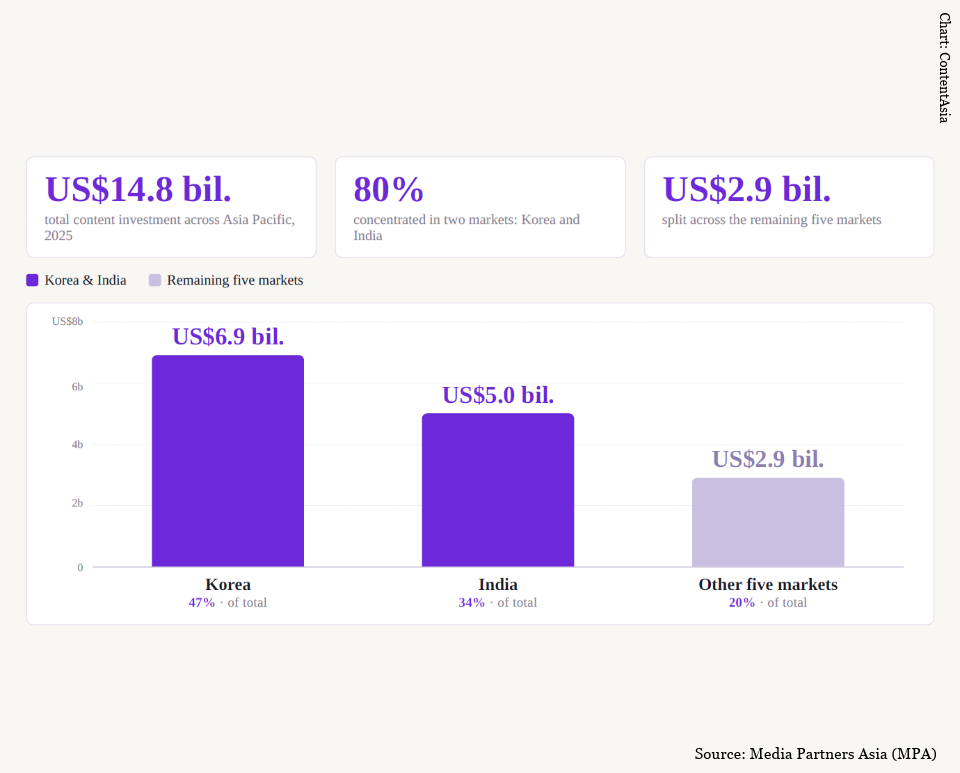
When it comes to content investment in seven Asian markets in 2025, Korea leads with 46.6% of the US$14.8 billion total. India is second with 33.8%. The other five markets split the approx 20% balance, Media Partners Asia says. As growth slows to a crawl between now and 2031, the good news is that investment isn’t being cut – just “reallocated”.
Korea and India dominate content investment in Asia, taking 80% of the total US$14.8 billion that Media Partners Asia (MPA) estimates was invested in video content across seven markets in 2025. Korea led with US$6.9 billion, followed by India at US$5 billion. The other five markets – Indonesia, Malaysia, the Philippines, Thailand and Vietnam – split the remaining 20%, or approx US$2.9 billion.
The total amount for 2026 is forecast to reach approx US$15.1 billion – an increase of US$300 million (or just over 2%) year on year. By 2031, total video content investment across the seven markets could reach just US$15.4 billion, according to the MPA report, Asia Video Content Dynamics 2026, released at the end of September.
Asia’s video industries, the report says, “continue to command large audiences, valuable brands and deep creative capability... but these strengths are not consistently converting into attractive financial returns”.
With many established media companies trading well below equity book value, MPA argues that “capital allocation, cost rationalisation and protection of genuine content advantages will increasingly separate companies that create value from those that let it dissipate”.
Key findings show that regional content investment “is being reallocated, not cut”, and local film has emerged as the region’s clearest growth opportunity. Vietnam’s box office rose 20% to US$213 million in 2025 with local titles taking 69% of revenue; Indonesia’s grew 10.5% to US$325 million with a 60% local share; India posted a record US$1.41 billion box office; and a stronger local slate is driving a substantial theatrical recovery in Korea in 2026.
“Television needs deeper rationalisation,” MPA says, adding that while viewing remains substant...
When it comes to content investment in seven Asian markets in 2025, Korea leads with 46.6% of the US$14.8 billion total. India is second with 33.8%. The other five markets split the approx 20% balance, Media Partners Asia says. As growth slows to a crawl between now and 2031, the good news is that investment isn’t being cut – just “reallocated”.
Korea and India dominate content investment in Asia, taking 80% of the total US$14.8 billion that Media Partners Asia (MPA) estimates was invested in video content across seven markets in 2025. Korea led with US$6.9 billion, followed by India at US$5 billion. The other five markets – Indonesia, Malaysia, the Philippines, Thailand and Vietnam – split the remaining 20%, or approx US$2.9 billion.
The total amount for 2026 is forecast to reach approx US$15.1 billion – an increase of US$300 million (or just over 2%) year on year. By 2031, total video content investment across the seven markets could reach just US$15.4 billion, according to the MPA report, Asia Video Content Dynamics 2026, released at the end of September.
Asia’s video industries, the report says, “continue to command large audiences, valuable brands and deep creative capability... but these strengths are not consistently converting into attractive financial returns”.
With many established media companies trading well below equity book value, MPA argues that “capital allocation, cost rationalisation and protection of genuine content advantages will increasingly separate companies that create value from those that let it dissipate”.
Key findings show that regional content investment “is being reallocated, not cut”, and local film has emerged as the region’s clearest growth opportunity. Vietnam’s box office rose 20% to US$213 million in 2025 with local titles taking 69% of revenue; Indonesia’s grew 10.5% to US$325 million with a 60% local share; India posted a record US$1.41 billion box office; and a stronger local slate is driving a substantial theatrical recovery in Korea in 2026.
“Television needs deeper rationalisation,” MPA says, adding that while viewing remains substantial, monetisation continues to weaken.
Thailand’s TV advertising fell 18% to US$422 million in 2025 and MPA concludes that several television industries “still carry more legacy capacity than their advertising economics can support”.
Television still accounts for around 60% of spend, online video 30% and film 10%, but virtually all incremental growth comes from streaming and film as television budgets decline, MPA says.
In India, streaming has overtaken TV and is scaling across the region. For the first time, online video in 2025 commanded 46% of India’s content investment overtaking 42% for TV. Indian users streamed 420 billion hours of online video in 2025. JioHotstar leads India’s premium VOD category with a 58% viewing share and over 180 million paying subscribers.
Sports is the key differentiator in streaming, MPA says, using JioHotstar in India, TVing and Coupang Play in Korea; Vidio in Indonesia; and premium VOD in Vietnam to support the finding.
JioHotstar’s cricket-led model lifted connected-TV reach 26% during IPL 2026; TVing’s exclusive KBO baseball rights grew subscribers from 5.3 million to 6.5 million; Coupang Play has assembled Korea’s broadest premium sports line-up; Vidio tiers Indonesian football, the Champions League and the Premier League across price points; and the FIFA World Cup helped lift Vietnam’s premium VOD viewing by 22% in 2026.
Meanwhile, MPA says “production is shifting from volume to sustainable economics. More selective TV and streaming commissioning is squeezing production-fee models, while value is concentrating among integrated studios and producers with recurring demand, IP ownership or diversified revenue”.
Korea combines Asia’s highest production costs with compressed 5%-10% drama production margins; Southeast Asia operates at lower costs but faces the same pressure as commissioning tightens.
MPA suggests that collaboration and restructuring “can unlock significant value”. India and Korea lead the move towards consolidation. Southeast Asia has been slower to follow, “but there are clear opportunities for collaboration and consolidation in Indonesia, Thailand and the Philippines”.
Published in ContentAsia's Oct/Nov 2026 Magazine
Previous

Next