






FEATURES

Asia’s Formats Ups, Downs and More Downs – ContentAsia’s Formats Outlook (2020-2025)
27 July 2026
A handful of deals have lit up Asia’s formats environment this year: Refinery Media’s “SupermodelMe”, which put vertical video front and centre of the IP adaptations conversation; the return of big-brand regional formats in “MasterChef Asia”; Mongolia’s appetite for adaptations, including the first version of NBCUniversal’s “Top Chef” for NTV, Univision, DDish and Look TV; and the halo effect of “The Traitors India” and its pickup on BBC in the U.K. A Korean version is in development with Luyworks Media and Something Special.
New Asia adaptations announced since January this year also include a new season of “The Face Vietnam” in a deal with Multimedia JSC after a three-year hiatus; seasons one to four aired between 2016 and 2023. The 10-episode fifth season, which leans heavily into the attention economy, will air on Vietnamese broadcaster VTV9 this October. It’s a nice uplift for Vietnam, which saw formats on air or commissioned plunge from 19 in 2024 to 5 in 2025 (Source: ContentAsia’s Formats Outlook).
Those followed a lively December 2025, when Sony Pictures Entertainment unveiled a new version of “Who Wants to be a Millionaire” for Japan along with the first adaptation of “Shark Tank” in Taiwan. The deals signalled an extended life span for classic formats in the region, and raised hopes of an uptick in North Asia pickups. Neither region has ever rivalled the formats enthusiasm displayed in South and Southeast Asia.
More broadly, NBCUniversal’s “Saturday Night Live” is the gift that keeps on giving in Korea, where the show has been running as “SNL Korea” across platforms since 2011.
“SNL Korea” debuted on streaming platform Coupang Play in 2021, and its return for multiple seasons has “one and only mission: comedy at its finest”, says Coupang’s Seoul-based production company CP Entertainment (see page 8). “SNL Korea” has won multiple Gold Awards at the annual ContentAsia Awards for Best Comedy Programme Made in Asia: in 2023 (season 3), 2024 (season 4) and 2025 (seasons 5 & 6).
The stickiness of reality in the new era of vertical video is still being tested against the overwhelmingly dominant hi-drama, and the release of Refinery Media’s 17-year-old made-in-Singapore modelling format, “SupermodelMe”, in a vertical format is being closely watched.
“SupermodelMe” entered Asia’s vertical video universe for the first time in March 2026 in an exclusive micro-adaptation backed by the COL Group’s FlareFlow micro-drama platform.
Executive producer and showrunner, Karen Seah, ta...
A handful of deals have lit up Asia’s formats environment this year: Refinery Media’s “SupermodelMe”, which put vertical video front and centre of the IP adaptations conversation; the return of big-brand regional formats in “MasterChef Asia”; Mongolia’s appetite for adaptations, including the first version of NBCUniversal’s “Top Chef” for NTV, Univision, DDish and Look TV; and the halo effect of “The Traitors India” and its pickup on BBC in the U.K. A Korean version is in development with Luyworks Media and Something Special.
New Asia adaptations announced since January this year also include a new season of “The Face Vietnam” in a deal with Multimedia JSC after a three-year hiatus; seasons one to four aired between 2016 and 2023. The 10-episode fifth season, which leans heavily into the attention economy, will air on Vietnamese broadcaster VTV9 this October. It’s a nice uplift for Vietnam, which saw formats on air or commissioned plunge from 19 in 2024 to 5 in 2025 (Source: ContentAsia’s Formats Outlook).
Those followed a lively December 2025, when Sony Pictures Entertainment unveiled a new version of “Who Wants to be a Millionaire” for Japan along with the first adaptation of “Shark Tank” in Taiwan. The deals signalled an extended life span for classic formats in the region, and raised hopes of an uptick in North Asia pickups. Neither region has ever rivalled the formats enthusiasm displayed in South and Southeast Asia.
More broadly, NBCUniversal’s “Saturday Night Live” is the gift that keeps on giving in Korea, where the show has been running as “SNL Korea” across platforms since 2011.
“SNL Korea” debuted on streaming platform Coupang Play in 2021, and its return for multiple seasons has “one and only mission: comedy at its finest”, says Coupang’s Seoul-based production company CP Entertainment (see page 8). “SNL Korea” has won multiple Gold Awards at the annual ContentAsia Awards for Best Comedy Programme Made in Asia: in 2023 (season 3), 2024 (season 4) and 2025 (seasons 5 & 6).
The stickiness of reality in the new era of vertical video is still being tested against the overwhelmingly dominant hi-drama, and the release of Refinery Media’s 17-year-old made-in-Singapore modelling format, “SupermodelMe”, in a vertical format is being closely watched.
“SupermodelMe” entered Asia’s vertical video universe for the first time in March 2026 in an exclusive micro-adaptation backed by the COL Group’s FlareFlow micro-drama platform.
Executive producer and showrunner, Karen Seah, talks about vertical as “simply another screen”. This is not, she says, “a pivot away from long-form. Film and television already co-exist... [I] never doubted that mobile would become a screen that mattered. Now it has”.
“SupermodelMe: Make It or Break It” releases this year, with Thai-American model and TV personality Cindy Bishop on board as host, along with judges Ase Wang and Patricia Gouw.
A spinoff male version – “SupermodelMe: The Runway Kings” – is in the works, also by Refinery Media for FlareFlow.
The series signalled more than a revival of a classic property that debuted in the pre-streaming world of 2009 as a web series, and went on to six seasons across multiple platforms, including linear channels AXN and KIX as well as a streaming slot on Netflix in December 2022.
In a universe of plunging numbers, the potential of the new format is heartening. The sticking point is funding. Commercial terms between creators, platforms and other partners are also a work in progress. The economics of vertical video production are the chalk to traditional production’s cheese. And the gap – even with sponsor backing – seems too wide to be closed.
Into the middle of the vertical debate is the return of traditional big-brand series “MasterChef Asia” – the first regional adaptation in more than a decade.
ContentAsia broke the story in March 2026, followed a month later by confirmation from Banijay and Warner Bros Discovery of a greenlight from sponsor – the Macao Tourism Board. There’s a bit of a backstory on the genesis of the project – and not everyone was equally happy about how it went down. But after all the tears are dried, the return across multiple markets raises hopes that tourism boards elsewhere will take note and open their purses.
“MasterChef Asia” production falls under Banijay’s CreAsia Studio (a venture with Endemol Shine India). Also name-checked in the announcement were Rashmi Bajpai, EVP Asia, Banijay Rights; Lynn Ng, GVP, head of content – APAC Networks at Warner Bros Discovery; Maria Helena de Senna Fernandes, director at Macao Government Tourism Office; and Deepak Dhar, founder & group CEO of Banijay Asia & Endemol Shine India.
The 10-episode series is scheduled to air this year on WBD-operated channels – TLC, Discovery and the Asian Food Network across India, Southeast Asia, Greater China and Korea, as well as on Lala TV in Japan and the Fatafeat channel in the Middle East.
Meanwhile, back at our data desk, traditional format volume in the region has, for the most part, fallen off a cliff. Scattered highlights break the doom, and hope springs eternal; but the numbers aren’t lying.
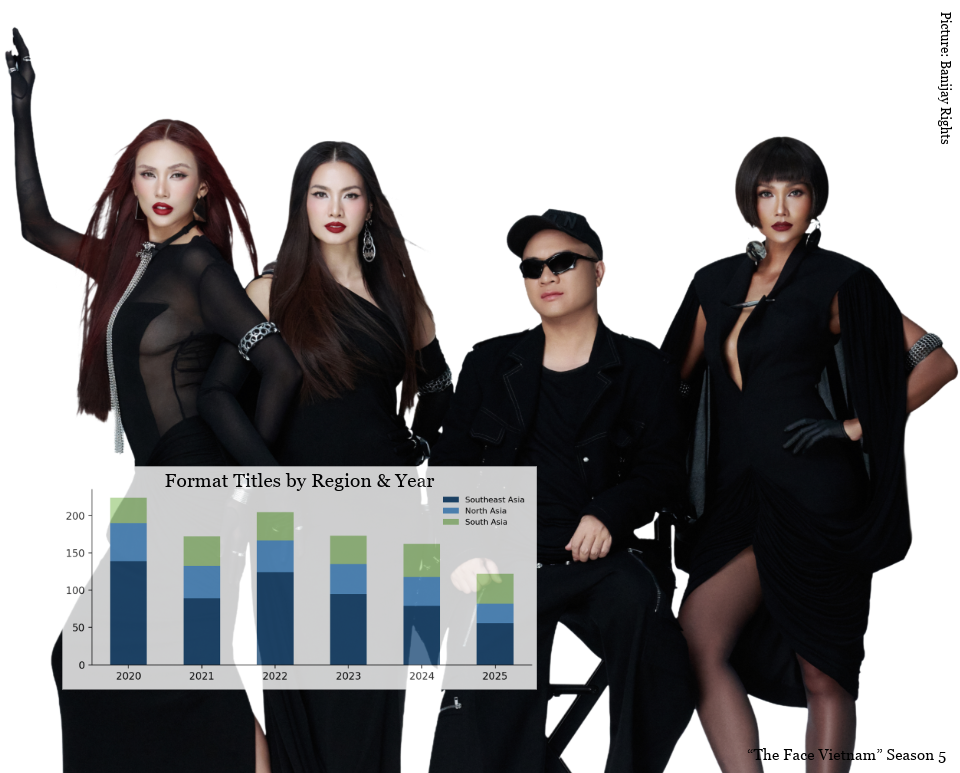
According to ContentAsia’s rolling Formats Outlook research, the decline has been steady since 2020, when 226 titles were on air or commissioned. This fell to 122 in 2025 – a drop of roughly 46% over the six-year period.
The steepest single-year fall was 2024-2025 (24.7% down), followed by 2020-2021 (-23.9%), reflecting the tail of pandemic-era production and commissioning disruption. Volume partially recovered in 2022 before resuming a decline through 2025.
Southeast Asia is the dominant market throughout the period, accounting for between 46%-62% of all titles, though it has also seen the largest absolute decline (from 139 in 2020 to 56 in 2025). South Asia is the only region to grow over the period, rising from 34 to 40. North Asia has halved, from 51 to 26.
At the title level, the market is highly fragmented; 893 of 897 distinct titles over the period appear in only one country. Returning seasons are high in Vietnam, Thailand and Indonesia, with India taking the lead in regional language versions of “Big Brother” (“Bigg Boss”). Mongolia also has lively activity around returning seasons.
From 2020-2025, India, Vietnam, and Thailand were the three largest markets by volume, together accounting for about 46% of all titles. India ended 2025 with a total of 178 adaptations since the beginning of 2020. Vietnam reached 162 and Thailand 145.
Banijay Rights was the single largest distributor in three of the top four markets (India, Vietnam, Thailand); Fremantle took the lead in Philippines and Indonesia; ITV Studios won Mongolia and Sri Lanka; MBC Korea led in Malaysia, and WBD was ahead in Japan.
Unscripted formats dominated the dataset (820 of 1,060 deals, 77%), led by Reality (349), Game Show (283), Music (154) and Variety (33).
Scripted formats accounted for the remaining 240 deals, concentrated in a handful of markets, notably Vietnam, Thailand and the Philippines. This mix is broadly consistent with the wider Asia formats trend of unscripted content driving the bulk of cross-border format licensing, while scripted remains a smaller but meaningful share.
INDIA: Streaming drives an expanded creative canvas
India moved into 2026 with a continued focus on adaptations, fuelled by multiple seasons of “The Traitors” on Prime Video, and higher interest than ever in social reality driven by the local version of France’s “The 50” on JioHotstar and Colors.
Prime Video renewed the Indian version of “The Traitors” for a second season on 25 June 2025, just 13 days after the first season premiered; during the announcement, All3Media and Prime Video said the series – produced by BBC Studios India – had been watched by viewers across 88% of India’s pin codes. Prime Video has also greenlit a Telugu adaptation of the hit Hindi series with Teja Sajja as host.
Ormax StreamView data released after “The 50” finale at the end of March amassed an unduplicated audience of 13 million across its run. Noting the show’s ability to “emerge from the shadows” cast by “Bigg Boss” (“Big Brother”), Ormax said the success “underlines the growing audience preference for the social reality sub-genre” in the reality category. “The 50” expanded an unscripted environment dominated by talent shows, with social reality benchmark set by “Bigg Boss”. Ormax attributed India’s willingness to experiment to streaming and the influencer economy, which it said expanded the creative canvas.
Top 12 Distributors in Asia (2020-2025)
ContentAsia’s Formats Outlook tracked 57 distributors around the world (including companies that have subsequently merged) from 2020-2025. Banijay Rights leads by a long way in volume over the six years, with 224 titles total across 17 markets. Banijay’s lead in Asia will surge with the combination of its assets with those of All3Media before the end of this year, giving the new entity a market share in Asia of more than 26%. That’s nearly double the next largest player – Fremantle – in Asia.
Banijay Rights is also the most geographically spread, active in 17 of the 20 markets/regions tracked.
The top three international majors (Banijay, Fremantle, ITV Studios) account for roughly 47% of all titles listed.
Below these, the market fragments quickly: CJ ENM is the leading Korea-originated distributor (70 deals, concentrated in Southeast Asia), and several distributors (Workpoint Group, ABS-CBN) operate as regional specialists active in only four markets.
At #13 is Warner Bros Discovery with 21 titles in eight countries, followed by Nippon TV with 14 in seven markets, and ABS-CBN with 14 in four markets.
For 2025 alone, Banijay was the top formats company in Asia, with 30 titles commissioned or aired/streamed.
The Philippines and Thailand both acquired/aired five Banijay titles in 2025, including two versions of “The Face Thailand” for Channel 3 and Netflix, and multiple versions of “Big Brother” for various platforms in the Philippines.
Banijay has also sold second and third seasons of game show format “LEGO Masters” into Japan. The adaptations were greenlit by TBS (Channel 6) and affiliated channels.
The other markets in Asia adapting Banijay formats are Cambodia (“MasterChef Cambodia” season 4 for CTN TV); China (“Puzzle Masters” seasons 8 & 9 for Jiangsu Satellite TV); Indonesia (“MasterChef Indonesia” seasons 12 and 13 for free-TV broadcaster RCTI); Mongolia (“Spelling Star Mongolia” season 3 for Edu TV & Dream TV and “Secret Life Of 5 Year Olds Mongolia” season 3 for Mongol TV); Pakistan (“MasterChef Pakistan” season 2); and Sri Lanka (“The Money Drop Sri Lanka” season 3 and 4, both for Sirasa TV, Kiki, and “MasterChef Sri Lanka” season 1 for platforms owned/operated by Independent Television Network Ltd (ITN) and Nilendra Deshapriya Productions (NDP).
According to ContentAsia’s rolling Formats Outlook research, four All3Media formats were aired or commissioned in Asia in 2025 – two in India (“The Traitors” seasons one and two for Prime Video), one in Korea (“The Traitors”) and one in Malaysia (“Step Dave” in Mandarin for Astro Malaysia).
Full Year 2025
122 formats from 20 distributors were commissioned or released in 17 countries across Asia in 2025 – the lowest-volume year since ContentAsia’s Formats Outlook started tracking regional data in 2017. The peak in volume terms was 2018, when we counted 337 titles, translating to a 64% decline over seven years.
Only one title recorded more than one country deal in 2025: “Run For Money” (Fuji TV, Japan), which placed in both China and Vietnam.
Southeast Asia remains the largest market in 2025 with 56 deals (46% of the total), followed by South Asia with 40 deals (33%) and North Asia with 26 deals (21%). Southeast Asia and North Asia have both continued their multi-year declines, while South Asia – the only region to grow over 2020-2025 – held broadly steady into 2025.
Banijay Rights was the top distributor for the year, with 30 titles or 25% of all shows, followed by Fremantle with 25 and Korea’s CJ ENM with 13. The other two distributors in the top five were ITV Studios (11) and Sony Pictures Television (7).
Together, the top three distributors accounted for roughly 56% of 2025 deal volume – a higher concentration than the 47% held by the top three across the full 2020-2025 window. This suggests that the market has consolidated further around fewer distributors in the most recent year. Banijay Rights was also the most geographically spread, active in 10 of the 17 markets tracked in 2025.
India, Philippines and Thailand were the three largest markets by volume in 2025, together accounting for roughly 48% of all shows commissioned or released. This mirrors the top-market pattern of the 2020-2025 dataset, though Philippines (17 deals) outranks Vietnam in 2025, while Vietnam falls to a five-deal, joint mid-table position.
Unscripted formats dominate 2025 (94 of 122 deals, 77%), consistent with the wider 2020-2025 trend. Reality (57 deals, 47%) and Game Show (31 deals, 25%) are the leading genres, followed by Drama (28, 23%), with Music and Variety each contributing 3 deals (2%).
Genre mix by region shows Reality concentrated in South Asia (26 of 40 South Asia titles, 65%) and Drama more evenly split across Southeast and North Asia. Game Show is Southeast Asia’s second-largest genre (18 titles) after Reality (23).
Previous

Next