







FEATURES

“Recovery is not always about change. Sometimes there is value in preserving something unchanged” – Tomohiko Yokoyama on “The Wind Phone: From Japan to the World”
10 October 2026
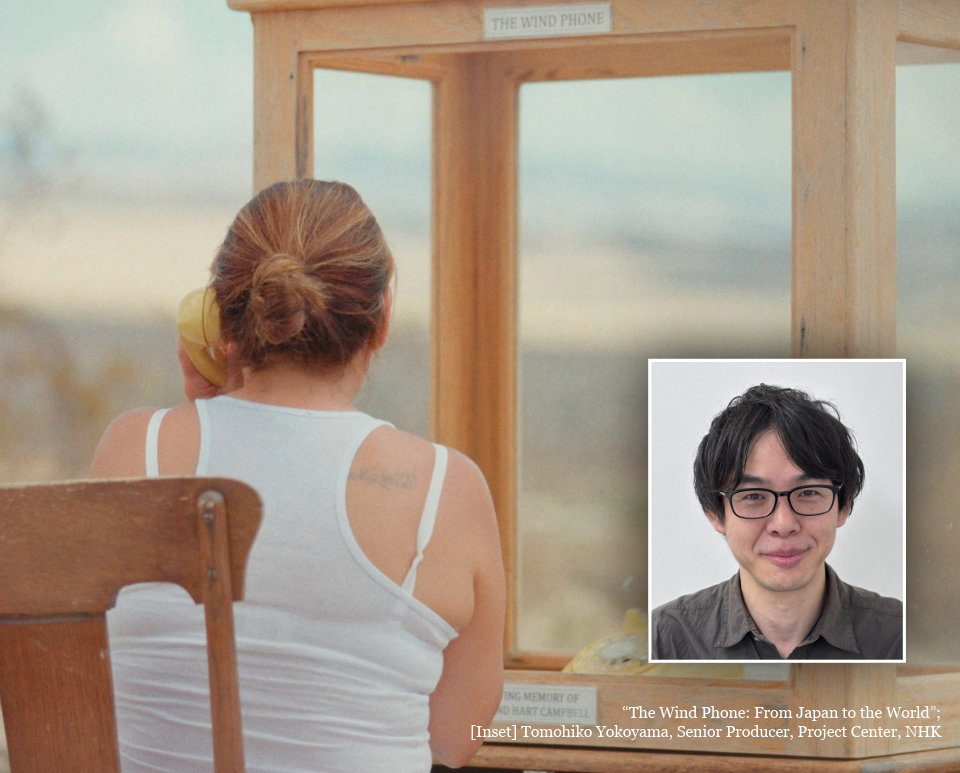
Tomohiko Yokoyama, NHK Senior Producer, Project Center, talks about a growing global network of Wind Phones that connect the living and the dead.
A silent, disconnected telephone booth stands on a windswept hill overlooking the sea in Otsuchi Town, Iwate Prefecture – an area devastated by the 2011 Great East Japan Earthquake and Tsunami. People come here from faraway places to speak to loved ones they have lost. And now, what have come to be known as Wind Phones have spread beyond Japan, with more than 500 established around the world. “The Wind Phone: From Japan to the World” (それからの、風の電話), winner of the ContentAsia Awards 2026 category for Best Factual Programme Made in Asia for Multiple Asia and/or International Markets, tells the stories of the people who visit the wind phones, each with their own circumstances and thoughts and feelings to share.
What drew you to the Wind Phone as a subject? Why did you do this programme now?
“I actually made a documentary about the Wind Phone once before, in 2016, five years after the Great East Japan Earthquake. Now, a decade has passed since then, making it 15 years since the 2011 disaster. As infrastructure reconstruction is mostly complete, the disaster is rarely talked about in the media, and much of what relates to it is increasingly described through the lens of ‘fading memory’.
What surprised me, however, was that the Wind Phone seemed to be following the opposite path. Rather than fading away, it was reaching more people and spreading further, even beyond Japan’s borders.
When I returned to visit the original Wind Phone in the Sanriku area, I found that people were traveling from overseas to this remote place in northern Japan, a destination that even within Japan requires a long journey involving multiple transfers on bullet trains and local railways. I became curious about why the Wind Phone continued to resonate so deeply with people from around the world.
That question was what motivated me to revisit the subject and create another programme about the Wind Phone.”
Meeting the bereaved families 15 years after the disaster, it at first seemed as though time had healed their emotional wounds. But in reality, that wasn’t the case at all; their wounds were still bleeding as if it had happened only yesterday. They were simply suppressing those emotions so as not to pour cold water on the societal narrative of “rec...
Tomohiko Yokoyama, NHK Senior Producer, Project Center, talks about a growing global network of Wind Phones that connect the living and the dead.
A silent, disconnected telephone booth stands on a windswept hill overlooking the sea in Otsuchi Town, Iwate Prefecture – an area devastated by the 2011 Great East Japan Earthquake and Tsunami. People come here from faraway places to speak to loved ones they have lost. And now, what have come to be known as Wind Phones have spread beyond Japan, with more than 500 established around the world. “The Wind Phone: From Japan to the World” (それからの、風の電話), winner of the ContentAsia Awards 2026 category for Best Factual Programme Made in Asia for Multiple Asia and/or International Markets, tells the stories of the people who visit the wind phones, each with their own circumstances and thoughts and feelings to share.
What drew you to the Wind Phone as a subject? Why did you do this programme now?
“I actually made a documentary about the Wind Phone once before, in 2016, five years after the Great East Japan Earthquake. Now, a decade has passed since then, making it 15 years since the 2011 disaster. As infrastructure reconstruction is mostly complete, the disaster is rarely talked about in the media, and much of what relates to it is increasingly described through the lens of ‘fading memory’.
What surprised me, however, was that the Wind Phone seemed to be following the opposite path. Rather than fading away, it was reaching more people and spreading further, even beyond Japan’s borders.
When I returned to visit the original Wind Phone in the Sanriku area, I found that people were traveling from overseas to this remote place in northern Japan, a destination that even within Japan requires a long journey involving multiple transfers on bullet trains and local railways. I became curious about why the Wind Phone continued to resonate so deeply with people from around the world.
That question was what motivated me to revisit the subject and create another programme about the Wind Phone.”
Meeting the bereaved families 15 years after the disaster, it at first seemed as though time had healed their emotional wounds. But in reality, that wasn’t the case at all; their wounds were still bleeding as if it had happened only yesterday. They were simply suppressing those emotions so as not to pour cold water on the societal narrative of “reconstruction” and “moving forward”. – Tomohiko Yokoyama, Senior Producer, Project Center, NHK
How long was the project in development and how long did it take to produce once you got the greenlight?
“I visited the Wind Phone again and began researching the project in March 2025. After that, I wrote a proposal and the project was formally approved in May 2025. The programme was completed in March 2026, so it took about a year from the initial proposal and roughly 10 months from the official greenlight to completion.
That said, my relationship with this story goes back much further. Some of the people featured in the programme had already been interviewed for my previous Wind Phone documentary, which I filmed in 2015 and 2016.
In that sense, although the production itself took about a year, the project is really the culmination of nearly 10 years of engagement with the people and stories connected to the Wind Phone.”
How did you convince people who use the Wind Phones to participate in the programme?
“Whenever I visited the Wind Phones, I would first introduce myself and explain the project, then ask whether they would be comfortable with us filming their visit and phone call. We only recorded those who gave their consent.
Because these conversations are deeply personal and are not intended to be heard by others, many more people declined than agreed to participate. Some people said it was fine only if their voice was recorded, and in those cases, we filmed them in a way that protected their anonymity. Even after filming, we carefully explained how the footage would be used and only included those who gave their final approval.
There were also people who had never disclosed to those around them that they had lost family members in the tsunami or were carrying emotional wounds related to the disaster. Some were concerned that appearing in the programme might reveal aspects of their personal history that even close friends or colleagues did not know about.
Even though they initially agreed to be filmed, some contacted me during or after the editing process, leading us to revise the editing or remove comments shortly before broadcast to address those concerns.
My impression was that many participants were less worried about themselves than about the impact their appearance might have on the people around them. They did not want to cause concern or place an emotional burden on family, friends, or members of their community.”
Grief is at the centre of every scene. What boundaries did you set for yourself and your crew about what to film and what to leave alone? Also, did you find a big difference in documenting the way Japanese and foreigners responded to the wind phone?
“I think many Japanese people, in particular, are accustomed to concealing their emotions. Meeting the bereaved families 15 years after the disaster, it at first seemed as though time had healed their emotional wounds. But in reality, that wasn’t the case at all; their wounds were still bleeding as if it had happened only yesterday. They were simply suppressing those emotions so as not to pour cold water on the societal narrative of “reconstruction” and “moving forward”.
I remember meeting one woman who told me, ‘This is the only place where I can cry as much as I want, alone.’ Behind the smiles people showed in everyday life, there was often a much deeper grief that had been carefully buried.
For us, the most important thing was not to force those emotions to surface. We did not want to draw out feelings for the sake of the camera. Instead, we placed great importance on simply waiting, so that we could capture only what emerged naturally.”
Sound clearly matters to a film about a disconnected telephone and the wind. How did you think about sound design and silence as storytelling tools rather than just atmosphere?
“We recorded and collected many of the individual sounds that can be heard around the Wind Phone and, in several parts of the programme, built sequences out of those sounds alone. Even the sound of the wind varies greatly. There are strong winds and gentle winds, warm winds and cold winds, and each season and time of day has its own character. To me, the wind itself seems to carry different emotions.
Beyond the wind, there are the sounds of birds, insects and waves. Those natural sounds seemed to make the telephone feel like something more than an ordinary object.
In fact, after the Great East Japan Earthquake, a new highway was built between the garden where the Wind Phone stands and the sea. In the past, visitors could see the ocean and hear the sound of the waves. Today, much of that landscape and soundscape is blocked, replaced by the noise of passing traffic. I felt that something of the site’s unique atmosphere had been diminished, so we tried to minimise those artificial sounds whenever possible.
As for the voices of the people speaking into the receiver, we deliberately kept editing to a minimum. We wanted to preserve their words as naturally as possible, including their pauses and even their breathing. I felt that those moments of silence and hesitation carry a sense of intimacy, allowing us to hear something deeply precious.”
“At the same time, too much explanation can diminish the immediacy and tension of listening to those conversations unfold in the moment. We therefore chose not to explain everything, instead trust the audience’s imagination and allow some things to remain unsaid.”
Did the presence of your cameras change how people spoke into the phone, and how did you work around that?
“This was something we were concerned about from the outset, so we adopted several approaches. We made sure we stayed out of people’s line of sight, filmed from as far away as possible, and in some cases used unmanned cameras. It’s possible that some people may have been conscious of the camera and spoken differently because of it. However, that was not something I felt happened very often. Once people picked up the receiver, many seemed to become completely absorbed in the conversation, forgetting that we were there. Perhaps that is the effect of the phone booth itself, or of the receiver as a device. Whatever the reason, many people ended up speaking in a remarkably natural and intimate way.”
What was the most difficult editorial decision, whether it was a scene you left out, an ordering choice, or how much context to give viewers unfamiliar with the tsunami?
“One of the biggest editorial challenges was finding the right balance between Japan and the wider world. The international spread of the Wind Phone was a major reason I wanted to make this film, but the story inevitably contains a great deal about Japan and the Great East Japan Earthquake. It was difficult to connect two distinct themes within a single narrative: the grief and recovery of those who lost loved ones, and the growing global reach of the Wind Phone.
Although we originally planned to finish with a big scene back in Japan, we ultimately chose to end the programme in the Netherlands to emphasise the latter theme.
Another challenge was deciding how much background information to provide about the person who created the Wind Phone and the people who visit it. The more viewers know about someone’s background, the easier it is to empathise with their words.
At the same time, too much explanation can diminish the immediacy and tension of listening to those conversations unfold in the moment. We therefore chose not to explain everything, instead trust the audience’s imagination and allow some things to remain unsaid.”
What surprised you most about the process of making this programme?
“One of the biggest surprises was the sheer scale of the Wind Phone’s spread around the world. When I began researching the project, we were aware of only a dozen or so Wind Phones outside Japan. But as the research progressed, the number kept growing. By the time the programme aired, we had identified more than 500. I was amazed that something created by one individual out of a deeply personal impulse had resonated with so many people across the world.
Another surprise came from a woman whose story ultimately could not be included in the programme because we ran out of time to finish it. She picked up the receiver and sat there for several minutes without saying a single word before quietly hanging up. At first, I thought the scene would be difficult to use because there were no spoken words. But when I listened to the recording, I was deeply moved. For several minutes, there was only silence and the occasional sound of her sniffing. If you listened carefully, you could tell that she was crying without making a sound. That experience reminded me that words are not the only way people communicate their feelings. Sometimes silence can speak just as powerfully. Not only that woman, but many of the people who visited the Wind Phone showed me things I never expected to discover.”
Are there any anecdotes or experiences making the programme that have stuck with you?
“One story that has stayed with me is that of Brian, who lost his brother to suicide and traveled from the United States to visit the Wind Phone with his family. He told me that seeing the town’s recovery had given him strength and helped him take a step forward in his own life. I found it remarkable that the memory of the Great East Japan Earthquake, which even many people in Japan are gradually forgetting, could resonate so deeply with someone from another country and become a source of healing. It reminded me that our ability to connect with one another is one of our greatest strengths. I feel fortunate to have been able to trace that chain of compassion, in which one person’s care for another continues to spread.
Personally, I love a phrase often used by Itaru Sasaki, the creator of the Wind Phone: “I’m simply waiting.” Every day, he tends the garden and waits for people who may or may not come. Doing that for a few days would be one thing, but he and his wife have continued this for more than 15 years.
As the physical traces and memories of the disaster gradually fade, one visitor told me, ‘This is the one place that never changes. It feels as if I’m being told it’s still okay to talk’.
That made me realise that recovery is not always about change. Sometimes there is value in preserving something unchanged. In an era when waiting has become increasingly difficult, Mr. and Mrs. Sasaki taught me that waiting may be one of the hardest and most meaningful forms of support.”
ContentAsia’s special interview series talks to winners of the ContentAsia Awards about how and why their shows were made, from the first idea to the final cut. The series puts the spotlight on original productions from across Asia and the people behind them.
Published on ContentAsia’s dedicated Awards platform on 10 October 2026. Access ContentAsia Awards Focus here
Previous