NEWS

“The Human Premium is Rising”, Deloitte Asia Pacific Says in New AI Report
16 November 2026
“AI is abundant but originality is scarce”, Deloitte Asia Pacific said today in a report that finds 7% of organisations are furthest ahead in AI transformation.
The report, based on a survey of 1,278 business leaders across 18 APEC economies and India, says that as AI becomes increasingly accessible across the business landscape, simply adopting AI will no longer be enough to differentiate organisations.
The report finds that when every company can buy the same intelligence, AI alone sets no one apart. “Advantage moves to what can’t be bought: people’s knowledge and judgement, customers’ trust, and the ability to learn,” the company said in the release announcement.
More than half (52%) of leaders surveyed rank embedding AI across their enterprise among their top three priorities, ahead of revenue growth (41%) and profitability (39%).
Yet most are not using it to transform their business, with fewer than a quarter using AI to rethink their business model.
The report finds the return lies in closing the ‘Originality Gap’ between what any company can buy and what only one company can own.
Some 71% of leaders have already deployed AI at scale within their organisations. Among them, 53% have implemented AI across multiple business functions, 14% have embedded AI into core business processes, and 4% say AI is now integral to their day-to-day operations.
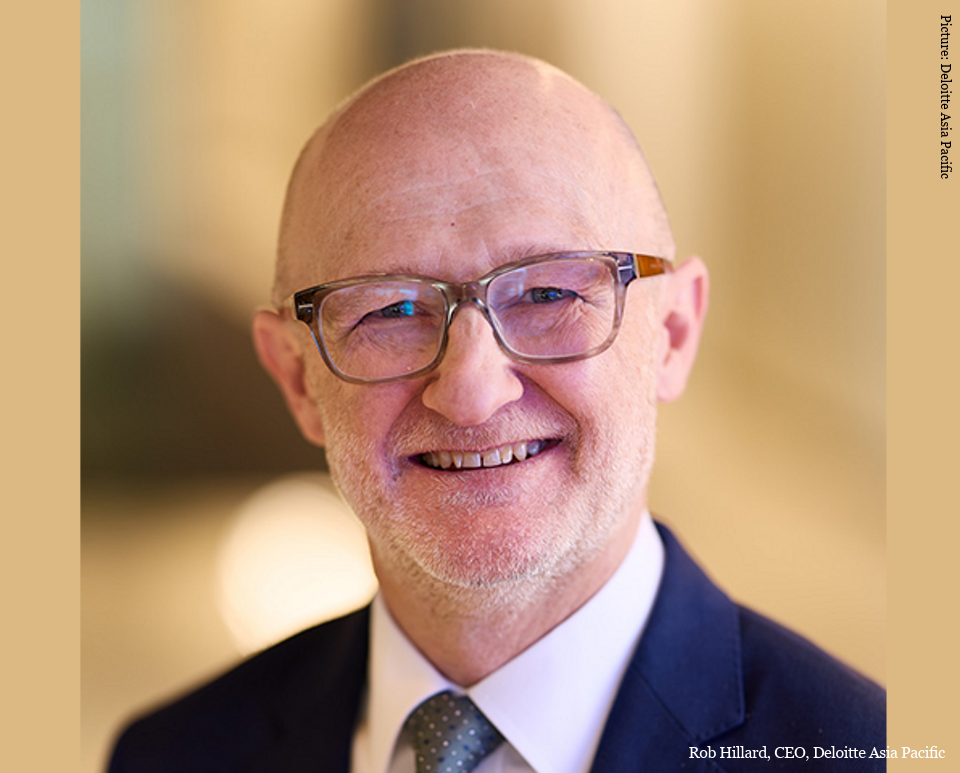
“Every company can buy the same AI. What they can’t buy is the distinctive knowledge, judgement and learning that turn it into competitive advantage,” says Rob Hillard, Deloitte Asia Pacific’s CEO.
“Closing the Originality Gap starts with leadership: understanding what your business knows, where your people create unique value and how AI can amplify both. This is the company’s intelligence signature, and it’s the CEO’s job to shape it,” he said.
“As AI becomes more accessible, differentiation gives way to commoditisation,” Deloitte Global’s AI leader, Nitin Mittal, added.
“The opportunity for CEOs is t...
“AI is abundant but originality is scarce”, Deloitte Asia Pacific said today in a report that finds 7% of organisations are furthest ahead in AI transformation.
The report, based on a survey of 1,278 business leaders across 18 APEC economies and India, says that as AI becomes increasingly accessible across the business landscape, simply adopting AI will no longer be enough to differentiate organisations.
The report finds that when every company can buy the same intelligence, AI alone sets no one apart. “Advantage moves to what can’t be bought: people’s knowledge and judgement, customers’ trust, and the ability to learn,” the company said in the release announcement.
More than half (52%) of leaders surveyed rank embedding AI across their enterprise among their top three priorities, ahead of revenue growth (41%) and profitability (39%).
Yet most are not using it to transform their business, with fewer than a quarter using AI to rethink their business model.
The report finds the return lies in closing the ‘Originality Gap’ between what any company can buy and what only one company can own.
Some 71% of leaders have already deployed AI at scale within their organisations. Among them, 53% have implemented AI across multiple business functions, 14% have embedded AI into core business processes, and 4% say AI is now integral to their day-to-day operations.
“Every company can buy the same AI. What they can’t buy is the distinctive knowledge, judgement and learning that turn it into competitive advantage,” says Rob Hillard, Deloitte Asia Pacific’s CEO.
“Closing the Originality Gap starts with leadership: understanding what your business knows, where your people create unique value and how AI can amplify both. This is the company’s intelligence signature, and it’s the CEO’s job to shape it,” he said.
“As AI becomes more accessible, differentiation gives way to commoditisation,” Deloitte Global’s AI leader, Nitin Mittal, added.
“The opportunity for CEOs is to move beyond simply deploying AI to redesigning work, coupling AI with human judgement and creativity, and building the capacity to learn faster. In the AI era, competitive advantage will increasingly come from creating something distinctive that others cannot easily replicate,” he said.
As AI takes on more of the work, the premium on human judgement and creativity rises.
“The next frontier is enabling people to create more value by framing the problems AI can help solve, setting the direction, and deciding what will matter to customers,” the company said.
“As intelligence becomes abundant, every organisation faces a choice: use AI to become faster and safer or use it to become more original. The leaders who define this era will be those who decide where judgment, creativity, trust and accountability must remain at the center because that choice reveals what the organisation truly values, what it will protect, what it chooses to preserve as distinctively human, and what it will amplify to create its Original Advantage,” said Nicole Scoble-Williams, Deloitte Global’s future of work leader.
Previous

Next