






NEWS

Ramadan: “No Longer a One-month Peak”; 2026 Marks an Inflection Point for MENA Content Economy, New Report Says
04 May 2026
2026 marks an inflection point for the content economy in the Middle East and North Africa, a new report by DICM says.
“For decades, Ramadan has been the cornerstone of television in MENA, a period defined by appointment viewing, family rituals, and peak advertising revenues,” the report – Ramadan 2026: The Reinvention of MENA’s Content Economy – says.
No more. “What was once a broadcast-dominated season has transformed into a sophisticated, multi-platform content ecosystem, one that reflects deeper shifts in technology, audience behavior, and monetisation strategies,” the report says.
Ramadan 2026 also marked a new phase in platform competition. “Rather than fragmentation, the market is moving toward consolidation through bundled offerings,” the research paper shows. These mix local Arabic originals, Hollywood blockbusters and premium international series in a single integrated subscription.
Citing data from the elCinema Report, DICM says about 244 original series – a 68% year-on-year increase – were produced across 17 Arab countries this year. “This growth signals a structural shift: Ramadan is no longer a one-month peak, but a strategic battleground for sustained audience engagement.”
Viewership patterns in 2026 highlight a decisive shift toward digital platforms. While traditional TV remains relevant, especially among older audiences, Connected TV (CTV) and streaming services now dominate consumption habits, with 56% of MENA viewers preferring digital-first viewing.
Ramadan’s unique lifestyle continues to shape engagement, the report says. Peak viewing occurs between 8pm and 2am, reflecting post-Iftar routines and late-night social habits. Average daily viewing surpassed five hours, with a 32% spike on the first day of Ramadan compared to the previous week.
“The message is clear: Ramadan audiences are no longer platform-loyal, they are content-loyal,” the report says.
Drama continues to be the undisputed driver of engagement. In Saudi Arabia, series-driven TV ratings nearly doubled, reinforcing scripted content as the core of Ramadan progr...
2026 marks an inflection point for the content economy in the Middle East and North Africa, a new report by DICM says.
“For decades, Ramadan has been the cornerstone of television in MENA, a period defined by appointment viewing, family rituals, and peak advertising revenues,” the report – Ramadan 2026: The Reinvention of MENA’s Content Economy – says.
No more. “What was once a broadcast-dominated season has transformed into a sophisticated, multi-platform content ecosystem, one that reflects deeper shifts in technology, audience behavior, and monetisation strategies,” the report says.
Ramadan 2026 also marked a new phase in platform competition. “Rather than fragmentation, the market is moving toward consolidation through bundled offerings,” the research paper shows. These mix local Arabic originals, Hollywood blockbusters and premium international series in a single integrated subscription.
Citing data from the elCinema Report, DICM says about 244 original series – a 68% year-on-year increase – were produced across 17 Arab countries this year. “This growth signals a structural shift: Ramadan is no longer a one-month peak, but a strategic battleground for sustained audience engagement.”
Viewership patterns in 2026 highlight a decisive shift toward digital platforms. While traditional TV remains relevant, especially among older audiences, Connected TV (CTV) and streaming services now dominate consumption habits, with 56% of MENA viewers preferring digital-first viewing.
Ramadan’s unique lifestyle continues to shape engagement, the report says. Peak viewing occurs between 8pm and 2am, reflecting post-Iftar routines and late-night social habits. Average daily viewing surpassed five hours, with a 32% spike on the first day of Ramadan compared to the previous week.
“The message is clear: Ramadan audiences are no longer platform-loyal, they are content-loyal,” the report says.
Drama continues to be the undisputed driver of engagement. In Saudi Arabia, series-driven TV ratings nearly doubled, reinforcing scripted content as the core of Ramadan programming.
Across the region, content preferences remain rooted in cultural relevance.
Egypt leans into social dramas and star-led productions, while Qatar emphasizes religious and historical narratives, and Morocco blends family series and comedy.
At the same time, a noticeable shift is underway.
“The industry is moving away from large-scale historical epics towards family melodramas, psychological thrillers, and light comedies with social themes. “This reflects both changing audience tastes and economic realities, as producers prioritise efficiency without compromising engagement,” the report says.
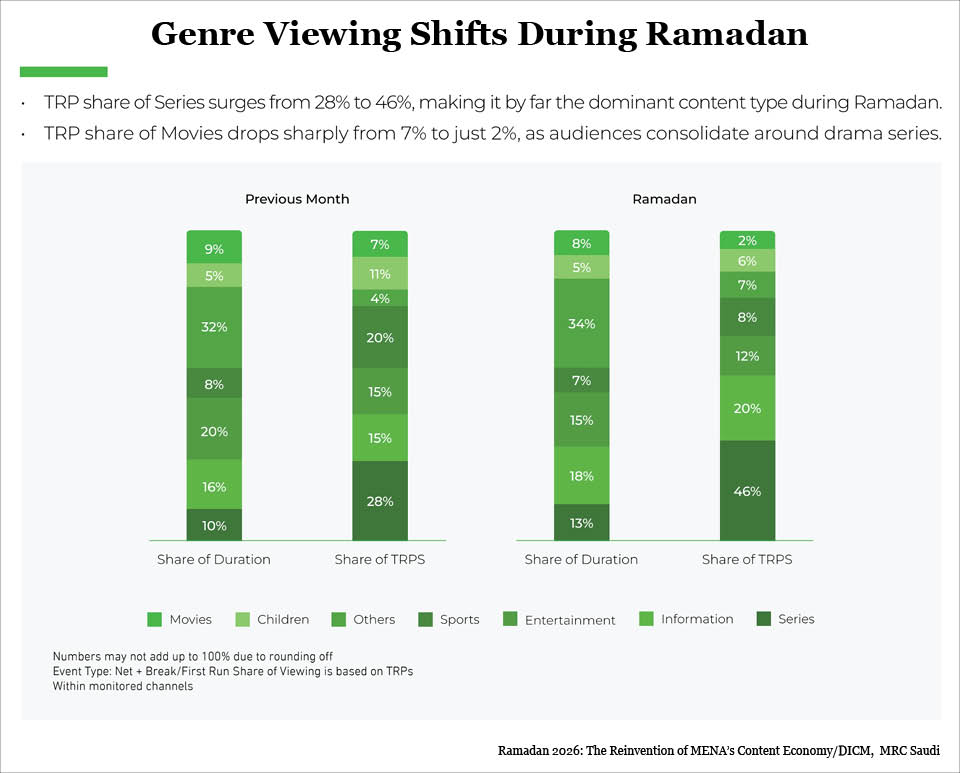
In Saudi Arabia, Ramadan 2026 reinforces a clear trend: series dominate audience attention.
Television Rating Point (TRP) share for series surged from 28% to 46%, making them the primary driver of viewing during the season. TRP share is the percentage of total TV viewing time that a particular content category (in this case, series) captured during a specific period.
In contrast, movies declined sharply from 7% to just 2%, as audiences shifted toward ongoing, episodic storytelling rather than one-off content. Other genres like entertainment, information, sports, and children’s programming remain present but play a supporting role, with significantly lower engagement.
The report pinpoints the dominance of the 15-minute drama format as “perhaps the most significant structural change in Ramadan 2026”.
“Once experimental, it has now become the industry standard,” the report says, adding that this shift is driven by multiple factors. These include faster storytelling with no filler episodes; viewer preference for shorter, bingeable content; cost efficiency, allowing more titles and talent diversity. “For younger audiences especially, the 30-episode format is increasingly seen as outdated,” it says.
In addition, mobile-first, bite-sized vertical storytelling is emerging as a fast-growing content format, with strong awareness translating into active consumption.
Another turning point this year is the clear rise of audio content, with double-digit increases in consumption.
“For broadcasters, platforms, and producers alike, the question is no longer just what to air during Ramadan, but how to build content ecosystems that sustain engagement long after it ends,” the report says.
Previous

Next