NEWS

“Reaching a global audience is an outcome not the goal” – Netflix
16 November 2026
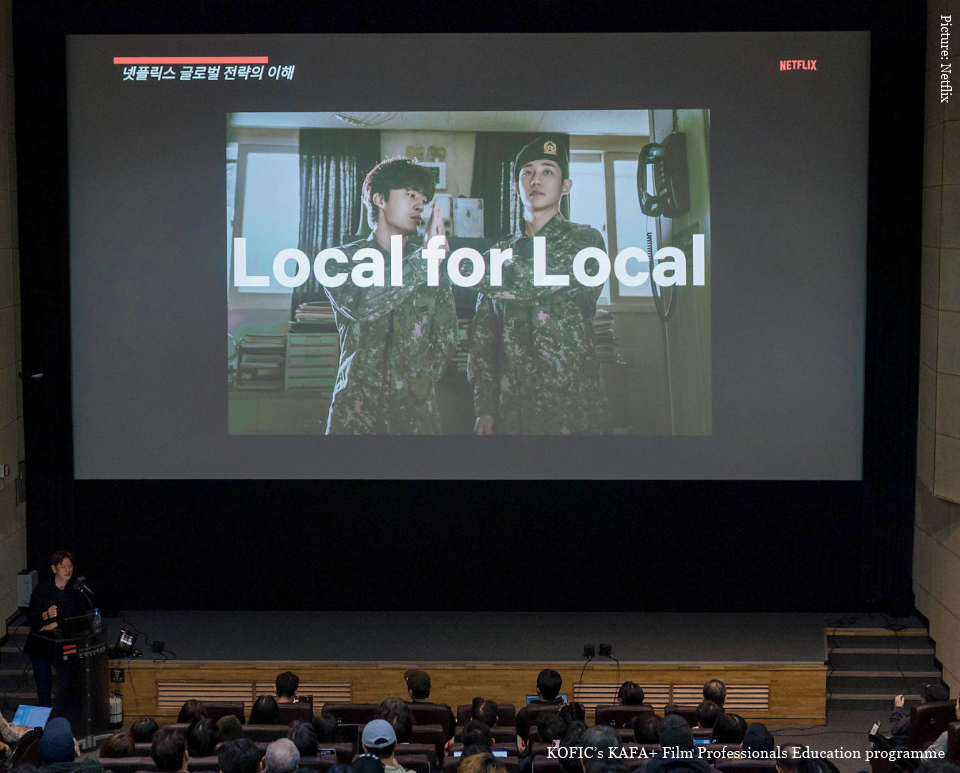
Korean stories travel best when they are written for Korean viewers first, Netflix told filmmakers in Korea during an event this month organised by the Korean Film Council (KOFIC) and the Korean Academy of Film Arts (KAFA).
“Reaching a global audience is an outcome, not the goal,” the streamer’s Korea content manager, Kijae Kim, said in a session called “Understanding Netflix’s Global Strategy: Developing Stories in the ‘Local for Local’ Era”.
From 2016 through 2025, Netflix worked with 80+ production companies in Korea and produced or co-produced more than 200 Korean titles.
Kim pointed to a range of creative approaches. Since “Yoo Byung Jae: Too Much Information” in 2018, titles like “Kingdom” and “Extracurricular” have explored new subjects and bold genres, he said.
“Squid Game” and “D.P.” brought stories rooted in Korean society to audiences around the world, while titles including “Physical: 100”, “Culinary Class Wars” and “Single’s Inferno” expanded the range of Korean unscripted shows.
“Local for local matters... starting with the stories Korean creators tell best and Korean viewers love to watch,” he said.
He added that putting a new spin on familiar elements is what sparked viewers’ curiosity and built anticipation.
Netflix continues to collaborate with creators across genres. Recent titles such as “Possible Love”, “The Glory” and “When Life Gives You Tangerines” reflected the breadth of those creative partnerships, he added.
Talking about production practice in a session titled “Understanding Netflix Production for Korea’s Screen Industry Professionals”, Jungsu Ha, director of production for Korea, outlined procedures and technical standards, which it shares with partners at the outset. These include pre-shoot “Respect” sessions, where cast and crew align on working safely on set.
On “Physical: 100”, for instance, the team consulted experts and ran simulations before filming to identify risk...
Korean stories travel best when they are written for Korean viewers first, Netflix told filmmakers in Korea during an event this month organised by the Korean Film Council (KOFIC) and the Korean Academy of Film Arts (KAFA).
“Reaching a global audience is an outcome, not the goal,” the streamer’s Korea content manager, Kijae Kim, said in a session called “Understanding Netflix’s Global Strategy: Developing Stories in the ‘Local for Local’ Era”.
From 2016 through 2025, Netflix worked with 80+ production companies in Korea and produced or co-produced more than 200 Korean titles.
Kim pointed to a range of creative approaches. Since “Yoo Byung Jae: Too Much Information” in 2018, titles like “Kingdom” and “Extracurricular” have explored new subjects and bold genres, he said.
“Squid Game” and “D.P.” brought stories rooted in Korean society to audiences around the world, while titles including “Physical: 100”, “Culinary Class Wars” and “Single’s Inferno” expanded the range of Korean unscripted shows.
“Local for local matters... starting with the stories Korean creators tell best and Korean viewers love to watch,” he said.
He added that putting a new spin on familiar elements is what sparked viewers’ curiosity and built anticipation.
Netflix continues to collaborate with creators across genres. Recent titles such as “Possible Love”, “The Glory” and “When Life Gives You Tangerines” reflected the breadth of those creative partnerships, he added.
Talking about production practice in a session titled “Understanding Netflix Production for Korea’s Screen Industry Professionals”, Jungsu Ha, director of production for Korea, outlined procedures and technical standards, which it shares with partners at the outset. These include pre-shoot “Respect” sessions, where cast and crew align on working safely on set.
On “Physical: 100”, for instance, the team consulted experts and ran simulations before filming to identify risks. On “Single’s Inferno”, participants went through health screenings, psychological assessments and background checks before filming, and were offered counseling afterwards.
On technology, Ha pointed to “Okja”, the first Netflix film to use both Dolby Vision and Dolby Atmos.
He also used the tug-of-war scene from season 1 of “Squid Game” to show how a sequence was planned before shooting, and which elements were built on set and which would be created with visual effects.
Choices as small as whether a window view is a printed backdrop or an LED screen can make a shot more convincing and save budget and time, he said.
Previous

Next