NEWS

Thailand: TrueVisions Group CEO, Birathon Kasemsri
26 November 2026
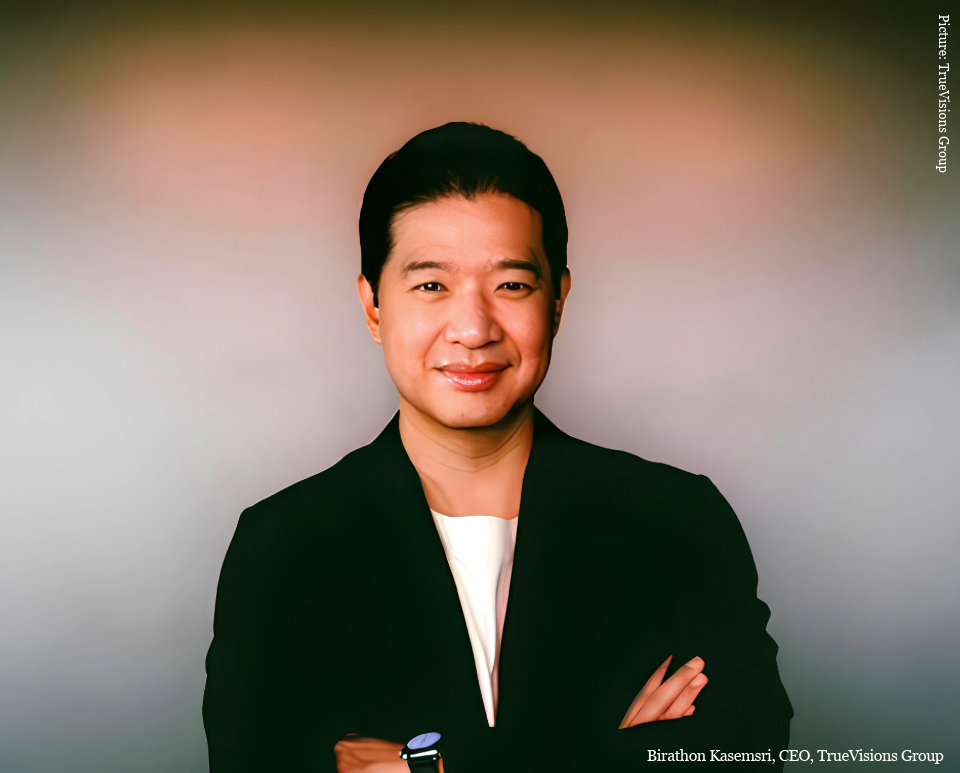
The content business of Thailand’s CP Group is pitching for a more significant role in the company’s broad consumer relationships. TrueVisions Group CEO, Birathon Kasemsri, talks about how and why.
When he took to the stage in Taiwan in November this year during government agency TAICCA’s annual TCCF industry event, the newly appointed TrueVisions Group CEO, Birathon Kasemsri, had two clear messages.
The first was to ensure no one left the room unclear about the sprawling empire of True’s parent, the CP Group, which is involved in everything from telecommunications, data centres and video entertainment platforms to raising chickens and supplying eggs. Plus real estate, cars, supermarkets and the 7-Eleven franchise...
The second was to make sure everyone watching him on the main stage knew that True was in the business of partnerships.
These include the 10-year-plus JV with Korea’s CJ ENM, run through the Seoul-based behemoth’s subsidiary, CJ ENM Hong Kong.
Kasemsri also said he would love to replicate True’s “historic” multi-party content supply agreement with Japan in Taiwan.
Announced in March 2026, the alliance with Japanese telco NTT Docomo, Japan’s Ministry of Internal Affairs and Communications, and Thailand’s National Broadcasting and Telecommunications Commission (NBTC) involves content from 66 Japanese broadcasters and is billed by True as an unparalleled soft-power initiative. Some proof of concept: the Japan alliance made True the only platform outside of Japan so far that has legal access to Japanese broadcaster TBS’ blockbuster Vivant season two, which it simulcasts with Japan.
“Understanding a culture visually is as important as understanding it via listening or tasting... This is where we come in,” he said.
Presenting Thailand as a strategic gateway to the ASEAN market, Kasemsri highlighted the country’s high connectivity (over 91% internet connectivity), large consumer base (population: 72 million), and a plethora of incentives.
He also outlined the CP Group’s diverse ecosystem, spanning telecoms, retail and media, all of which enable an “omni-channel” strategy.
The content piece itself is as diverse, including most recently a focus on microdrama. The vertical experience is...
The content business of Thailand’s CP Group is pitching for a more significant role in the company’s broad consumer relationships. TrueVisions Group CEO, Birathon Kasemsri, talks about how and why.
When he took to the stage in Taiwan in November this year during government agency TAICCA’s annual TCCF industry event, the newly appointed TrueVisions Group CEO, Birathon Kasemsri, had two clear messages.
The first was to ensure no one left the room unclear about the sprawling empire of True’s parent, the CP Group, which is involved in everything from telecommunications, data centres and video entertainment platforms to raising chickens and supplying eggs. Plus real estate, cars, supermarkets and the 7-Eleven franchise...
The second was to make sure everyone watching him on the main stage knew that True was in the business of partnerships.
These include the 10-year-plus JV with Korea’s CJ ENM, run through the Seoul-based behemoth’s subsidiary, CJ ENM Hong Kong.
Kasemsri also said he would love to replicate True’s “historic” multi-party content supply agreement with Japan in Taiwan.
Announced in March 2026, the alliance with Japanese telco NTT Docomo, Japan’s Ministry of Internal Affairs and Communications, and Thailand’s National Broadcasting and Telecommunications Commission (NBTC) involves content from 66 Japanese broadcasters and is billed by True as an unparalleled soft-power initiative. Some proof of concept: the Japan alliance made True the only platform outside of Japan so far that has legal access to Japanese broadcaster TBS’ blockbuster Vivant season two, which it simulcasts with Japan.
“Understanding a culture visually is as important as understanding it via listening or tasting... This is where we come in,” he said.
Presenting Thailand as a strategic gateway to the ASEAN market, Kasemsri highlighted the country’s high connectivity (over 91% internet connectivity), large consumer base (population: 72 million), and a plethora of incentives.
He also outlined the CP Group’s diverse ecosystem, spanning telecoms, retail and media, all of which enable an “omni-channel” strategy.
The content piece itself is as diverse, including most recently a focus on microdrama. The vertical experience is accessed through TATANG by TrueID, which rolled out in July this year as the first vertical drama service built for Thai audiences.
TATANG unites leading global content partners, including DramaBox and the COL Group’s FlareFlow, offering over 40,000 vertical-drama episodes. International titles are fully localised for Thai audiences — across language, dubbing, cultural adaptation and viewing experience — alongside a growing pipeline of Thai originals and co-productions with local creators.
Kasemsri outlines an “octopus strategy” (aka a mini app strategy), which he says aggregates the best short-form drama services into one app, with full digital security.
The strategy includes inserting short-form drama into all of True’s digital windows, including streaming, telecoms, e-payment app, e-commerce and websites. This enables at least six ways to monetise short-form content. An example he gives is that viewing earns consumers points; the points can be redeemed for a hotdog at 7-Eleven. “We pay consumers to watch... We call it the developing market model,” he says.
A few months post-launch, Kasemsri says the most downloaded app in Thailand is DramaBox. He says that more than 12 million True customers watch short-form drama daily from 6am to midnight, with peak viewing at 8am. From True’s telecom stats, short-drama had 54 million active users in October – year-on-year growth of 2.3x.
Kasemsri doesn’t subscribe to the notion that microdrama is different and separate from long-form content. “We think there’s a hybrid,” he says. “The most important thing is, ‘how does anyone reach consumers and make money from them?’ We think that short-form vertical is the perfect content format for companies like us that are telecom providers. It’s perfect for mobile. It’s perfect for any-time consumption, snacking.”
Of course AI fits in there somewhere. “We are experimenting, with AI and other new things,” Kasemsri says, drawing attention, too, to a curriculum for universities to study the creation, the production, and the commercialisation of vertical drama.
“This is an example of how we’re trying to embrace new trends and really try to figure out how to develop our market to be the hub,” he adds.
Long-form production runs alongside the micro boom. True, through its True CJ JV, is, in addition to backing remakes of “Bad Guys”, in production on two spin-offs of KBS Korea’s drama series IP “Good Doctor”. The two series are “The Mad Doc”, which involves traditional Thai medicine, and “Doctor Idols” about a Gen-Z doctor.
Working towards creating a “universe” for the brand, True is consolidating both new series into the second season of the “Good Doctor” adaptation. “We hope to license the new titles back to Korea,” he says, referencing the IP extensions as an example of the kind of innovation True is supporting.
There is also the in-house premium drama slate for 2026/7 under the subscription TV service TrueVisions Now. The 34 titles commissioned from about 20 production houses are part of True’s most ambitious slate ever, and include everything from erotic horror and religion to medical drama and a webtoon-based period rom-com.
Underlying all this is the November 2026 restructure that puts Kasemsri in charge of all True’s content – and, among other things, changes the way True’s legacy channels and production businesses move forward. And that, at one of the oldest platforms in Asia involving people who have been around since what seems like the beginning of time, is at the top of our watchlist for 2027.
Published in ContentAsia's December 2026 Magazine
Previous

Next