






NEWS

“We didn’t think we would make people cry” – Malaysian writer/director Nizam Razak on “Papa Zola The Movie” as it heads abroad after a record domestic box-office run
12 January 2026
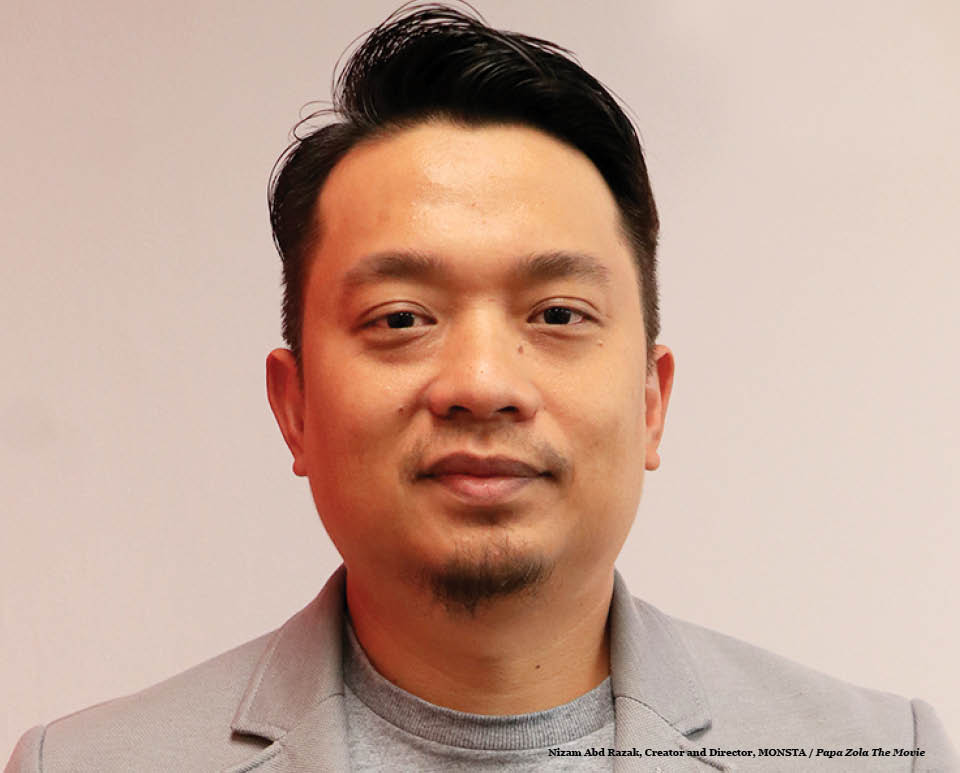
Malaysia’s latest animated blockbuster, “Papa Zola The Movie” heads to Indonesia later this month as part of a 13-country international release over the next four months, including Turkey, India and Saudi Arabia. At home, box office is RM 55 million/US$13.5 million in 27 days and counting, giving the country’s Monsta another win after “BoBoiBoy” and “Mechamato”.
Monsta CEO and director Nizam Abd Razak says “Papa Zola The Movie” marks a deliberate creative shift for the Malaysian animation studio, moving away from traditional shonen-style superheroes towards a more emotionally grounded, adult protagonist.
The shift was a calculated risk, Razak told ContentAsia. “People knew Papa Zola, but not this side of Papa Zola,” he said, describing Papa Zola as “a very ordinary hero, a family hero” — a hardworking father battling personal struggles rather than external villains alone.
The film’s emotional core lies in everyday perseverance, sacrifice, responsibility, and the challenges of fatherhood – themes Razak believes resonate far beyond Malaysia. “Papa Zola The Movie” is produced by Monsta and Astro Shaw, with MD Pictures supporting the international rollout.
Here's what else he said...
Papa Zola is built around a very ordinary, hardworking father. Why was it important for you to center the story on this everyday struggle instead of a more traditional hero?
Traditionally, we always do this shonen superhero... Why we chose Papa Zola is because that I think it's time for us to explore a different kind of hero rather than a superhero. [Papa Zola] is a very ordinary hero, a family hero, someone who actually battles on personal level. Of course, there's a concept of simulation, game and alien invasion. But I think this everyday perseverance is more relatable to the audience. We also wanted to reach out to the older audience – parents, dads, and portray their struggles in a form of animation. That's why we actually choose Papa Zola. So Papa Zola used to be just a side character in "BoBoiBoy" franchise. Now we want to center him as the father figure, as an adult figure going through his struggles, providing for his family, being there for his wife and also daughter.
You tapped a side character from "BoBoiBoy", which is one of Malaysia's best known titles. Did you go into the project a bit more confident than creating something from scratch?
"Yes and no. We have "...
Malaysia’s latest animated blockbuster, “Papa Zola The Movie” heads to Indonesia later this month as part of a 13-country international release over the next four months, including Turkey, India and Saudi Arabia. At home, box office is RM 55 million/US$13.5 million in 27 days and counting, giving the country’s Monsta another win after “BoBoiBoy” and “Mechamato”.
Monsta CEO and director Nizam Abd Razak says “Papa Zola The Movie” marks a deliberate creative shift for the Malaysian animation studio, moving away from traditional shonen-style superheroes towards a more emotionally grounded, adult protagonist.
The shift was a calculated risk, Razak told ContentAsia. “People knew Papa Zola, but not this side of Papa Zola,” he said, describing Papa Zola as “a very ordinary hero, a family hero” — a hardworking father battling personal struggles rather than external villains alone.
The film’s emotional core lies in everyday perseverance, sacrifice, responsibility, and the challenges of fatherhood – themes Razak believes resonate far beyond Malaysia. “Papa Zola The Movie” is produced by Monsta and Astro Shaw, with MD Pictures supporting the international rollout.
Here's what else he said...
Papa Zola is built around a very ordinary, hardworking father. Why was it important for you to center the story on this everyday struggle instead of a more traditional hero?
Traditionally, we always do this shonen superhero... Why we chose Papa Zola is because that I think it's time for us to explore a different kind of hero rather than a superhero. [Papa Zola] is a very ordinary hero, a family hero, someone who actually battles on personal level. Of course, there's a concept of simulation, game and alien invasion. But I think this everyday perseverance is more relatable to the audience. We also wanted to reach out to the older audience – parents, dads, and portray their struggles in a form of animation. That's why we actually choose Papa Zola. So Papa Zola used to be just a side character in "BoBoiBoy" franchise. Now we want to center him as the father figure, as an adult figure going through his struggles, providing for his family, being there for his wife and also daughter.
You tapped a side character from "BoBoiBoy", which is one of Malaysia's best known titles. Did you go into the project a bit more confident than creating something from scratch?
"Yes and no. We have "BoBoiBoy" have "Mechamato"... So people always expect from us a very over the top, spectacle superhero... they already know Papa Zola, but not this side of Papa Zola. So what we were so afraid of was that people were not used to this kind of storytelling, maybe wanted more of a spectacle, super upgrade powers. So in a way it helped to let the current audience know about Papa Zola, but it was also a double-edged sword. Maybe they wanted something else? And then we provided them an ordinary story about a father struggling. But for now, at least among the Malaysian audiences, they really like it, so we are quite relieved.
At what point did you realise that the story was connecting on a scale that was just beyond the typical Malaysian animation?
When we saw the reaction from the audience. This is the age of social media – TikTok, Instagram... they actually recorded themselves after the movie or during the movie, not watching, not the film itself, but their reaction. So a lot of them, and their children, they laugh, they cry. And a lot of them said that after the movie, their wife, their children actually hugged them and said thank you. Then we really knew. From that we realised this is not a typical movie. This is a movie that impacted the audience. So there are kinds of movies that are very nice to look at, but this movie felt very different. A lot of people asks us: was this originally planned? Do we expect this? Not really. We knew that this movie has a certain set that's very emotional, but we didn't think that it could bring their tears down... So when they hug their parents, when we see like relief, a father figure, a father, actually, they really cried in the cinema. So we know this is something else. So we're very happy to be here and to receive this kind of feedback. It's not about the numbers... how the movie impacted the audience is more important for us.
Has this always been your approach I mean you are very commercial organisation...
For Papa Zola, not so much. "BoBoiBoy", yes. "Mechamato", yes. Those are very commercially driven IP. For example, "Papa Zola", you cannot see a lot of merchandise. He is not a character that is merchandisable, I would say. He's not commercial character. He's funny looking, his mustache is funny, his haircut is funny, his dad jokes... But there are some commercial elements. For example, we have what we call the Power Sphere, a cimubot, which is very cute, very commercial, but not for Papa Zola, who is more of a side character. Maybe it's Pippi Zola, right? So it's not really fully commercial because as a studio, as a director as well, we wanted to try different kinds of storytelling. We know if we just stick only for commercial, we always end up with shonen, superhero again and again. It's not that we don't want to do it, but we want to have a different track to explore our creative freedom.
Are you a father?
Yes, yes definitely. I have three kids.
Did you make this for your kids?
Yes, of course. I told my kids, some of the scenes are actually from my experience as well. For example, there's a scene where Mama Zila, the wife of Papa Zola, helps him by giving her savings. So that actually happened in real life... I can only write this kind of film and direct this kind of film when I have gone through that stage. So when I first started with "BoBoiBoy", I was only like 20-over years old. So I'm a father, but hadn't really, really sunk into that fatherhood yet. So after like 10 years, 15 years, then I want to tell that part of story, but in the form of animation.
So it's you growing up as a writer director and growing into your role as a father.
Yes, definitely. If not, I could not write "Papa Zola". Maybe I could write the funny part of "Papa Zola", but not the emotional part.
How conscious were you of balancing deeply Malaysian sensibilities with themes that could track internationally, because the film does have quite a wide international footprint, which we'll talk about in a minute. But how did you balance these two – possibly conflicting – needs?
When we first got the idea for "Papa Zola", we made sure that the premise or the overall story, overall concept would be internationally accepted. For example, it's about alien invasion, right? So this alien invasion is coming to Earth and they will activate a dome where we turn the city into a game-like setting, right? So that is very ⁓ recognisable by everyone – game, simulation, aliens. But the background, the characters are from Malaysia. So we have to make sure that the balance in terms of the concept can be accepted, but this character can be a local character that must resonate with the international audience with emotion. I think every father across the globe, knows they need to sacrifice for their family. So I think that is universal, about love, about sacrifice. So I think in terms of emotion, I think that can travel.
Obviously, you're writing for the local market first and the international market, which you hope will follow. Has the international footprint been broader than you thought?
Before we launched the movie in Malaysia, we presented the trailer in certain markets, and we told that this could work, especiall in the global south, in parts of Europe like Spain, Portugal, Italy and Turkey, also in India. So in that sense, we're not surprised.
What creative risks did "Papa Zola" allow you that "BoBoiBoy" or "Mechamato" didn't?
I think the most risk that we took was on Papa Zola himself, because this is an adult character. This adult character might not look commercial. So that's very risky. We look at the as a business, I'm also the business owner. So we look at the market, we know we have the shonen, we know we have the superhero, BoBoiBoy and Mechamato. Now we want to tackle the family audience. So we know we need to do things very differently. So we took the risk of making "Papa Zola", originally a side character, into the main character. If this failed, this could tarnish the brand of Monsta itself, because we are so known for "BoBoiBoy" and "Mechamato". What if this is a failure? Then we say that, Monsta tried something new but they failed. Now they need to go back to shonen. So that's a huge risk for us but fortunately, at least in the Malaysian market right now, it seems to work. So we can use that experience in bringing stories with more emotional scene, more character depth and maybe apply that as well into our next shonen characters, "BoBoiBoy" and "Mechamato" as well.
How did you cast voice actors for "Papa Zola"?
"Typically one would use well-known voice actors, even in Malaysia. In "Papa Zola", we have one or two one celebrities but most of the characters are originally from the series. We don't use the artists to boost marketing. So our calculation is bit different. But I think animation has its own advantage going into international market. It's easy to make changes, in lipsynching for example, or skin tone, or outfits to make them more suitable for cetain markets.
Was there any particular emotional moment in the film that you thought, 'okay this might not travel but I'm going to do it anyway'?
I think some of the jokes of "Papa Zola" were really really funny when I wrote them. But I wondered, how are we going to translate this for international markets, into other languages? Papa Zola's jokes are so iconic in Malay. Now we are doing the international version. As we speak, our team is going through make sure that the script, the dubbing can be understood. Sometimes we need to adjust the context of the joke, maybe change the context of the script. It's sort of a regret for us, but for the Malaysian market, it needs to be told in that specific way. Now we need to challenge ourselves, how do we change that into a version that can be understood in English and also in other languages?
For example...?
Papa Zola always says "kebenaran". "Kebenaran" in Malay can easily resonate with the audience, but "kebenaran" means the truth or justice. Papa Zola calls himself "kebenaran" – the truth. But if you go into the international market and say: "I'm the truth". It's not that funny, right? So we look at how to translate that, not directly but using different wording, to find a different way of saying it so that the feeling is the same. We learned from the Japanese as well. A lot of Japanese anime, if you understand Japanese, is really, really funny. But then they translate it into English, and the jokes are lost in translation or are not funny anymore. But people can still enjoy this overall story without feeling awkward."
Do you see "Papa Zola" as a turning point for Malaysian animation globally?
For me, it's more of a signal if it is accepted on the international stage. If it is accepted internationally, maybe it proves that authenticity can travel without limitation, proves that Malaysian stories have global value. I think nowadays, for example, if I'm in the 1990s and I say that, one day in 2020 and beyond, Korean movies, Korean drama, Korean bands would be number one, I think people would wonder what you are talking about in 1995, right? But 30 years after that, you see that Korean content actually can travel. So it gives us hope. Maybe the global audience wants to see more than just Hollywood. Maybe the global audience, because we have been consuming Hollywood for maybe 50 years, maybe they still want to watch Hollywood, the Westerners' point of view. But maybe they want to see the Asian side. Maybe different cultures have something different to offer. We look at the Japanese, now the Korean. From China, for example, "Ne Zha". So it's very interesting. Hopefully we can also tap into that as a Malaysian; maybe not as Malaysian only, but more as Southeast Asian. How can we bring this story about a struggling father. The backdrop is Kuala Lumpur, and the background is culturally different, but the love, the sacrifice is hopefully universal enough.
What is your creative challenge right now?
I'm writing for the "Mechamato" movie 2. I'm also directing "BoBoiBoy" movie 3. So now after "Papa Zola", we know that the audience, at least in Malaysia, they want something more than a spectacle, something more than just power upgrade. So we need to make sure that we can deliver that. The challenge is to bring stronger drama, to make sure that BoBoiBoy is not just a kid superhero show, we need to add layers of drama, maybe a relationship with his father, his grandfather. So I think we need to gear up for that.
As a creator, who or what is your biggest inspiration?
I grew up in reading "Doraemon", until I was what, 11, 12, then when I'm in middle school, high school, I started to go into "Dragon Ball", but in comic form, right? Then I went to study animation, which is where I started to discover Miyazaki's work, Studio Ghibli. That's a huge inspiration for me, very artistic. It's not typical, in a way, not the typical plot, not typical structure, but it gives you another dimension. When you look at Hollywood animation, you can sort of predict the plot act one, act two, act three. But Miyazaki just brings you into his own world. So I kind of love that. That's a huge inspiration for me. So usually from the Japan side, "Doraemon", "Dragon Ball", "Kamen Rider". I think as a Malaysian because yes, we do have exposure from the likes of Marvel, Disney, but maybe because it's the Asian thing. At least for me, I'm more connected to the Japanese side of the media, at least on the superhero and animation side of things. But I still love "Shrek". My favorite animation is "Shrek 2".
What's your view on elevating Malaysian content?
We started this in, I think, in 2000. So we had this ambition as an industry, not myself, as an industry. We wanted to go global. There are two ways to do it. We were told we need to learn from the Westerners, to do servicing for them. So I said, OK, that's one route. But we need to tell our story; of course, the quality is not there. But I told the government, I said, 'you need to help us, continue to support local creators. So maybe one day, maybe in 10, 15 years, we can catch up, at least match certain expectation of quality. We can have more, we have the experience to tell a better story and give us a chance. The good thing is the government give us the chance, keeps on supporting us.
The audience is the most challenging part. For example, our ticket is about 20 ringgit, 20 to 25 ringgit. "Avatar" costs the same, 25 ringgit as well. Of course, IMAX is a different price, but on a normal screen... so they need to choose. Why choose our product? We need to make sure that our quality is not on par, but that the value of RM20 is worth paying for. So that's always been our challenge, but we are very thankful to the audience. They kept on supporting us so that we can go into this craft, producing and experiencing movies so that we can actually improve movie after movie. If you look at Monsta's journey, you can see our first movie, the quality of our first movie, my directing first movie. It's not that it's great right now, but at least we have some progress.
Note: The original interview has been edited for print.
Previous

Next