







FEATURES

ContentAsia Awards Focus: “Everyone Deserves a Chance to Rebuild Their Life”
15 September 2026
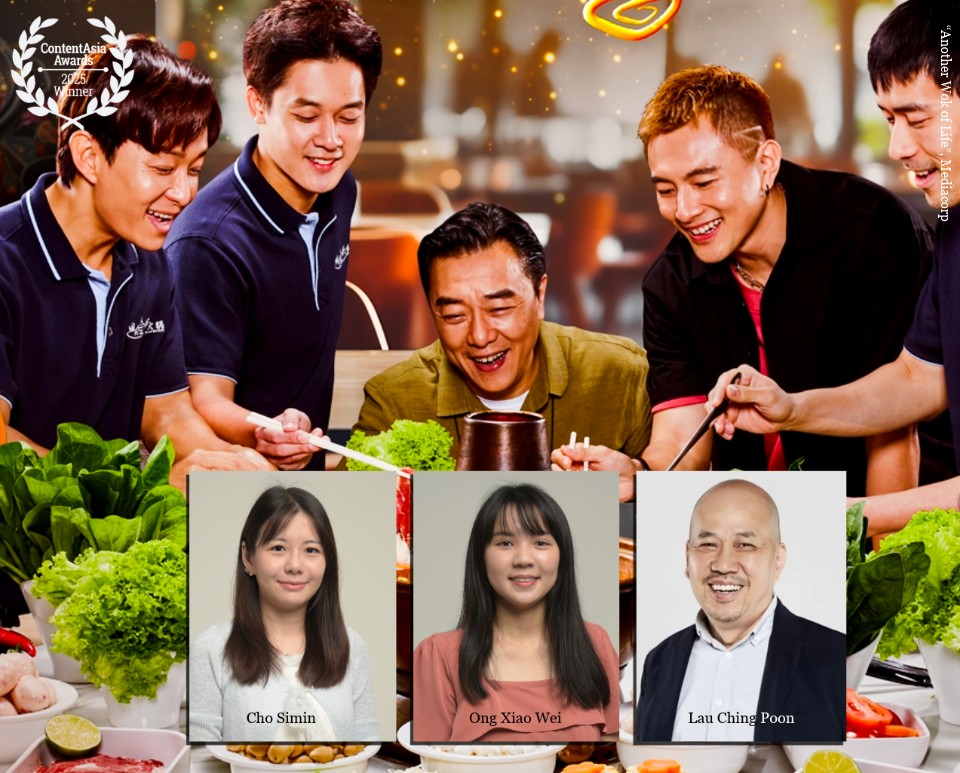
A former convict with a knife phobia rebuilds his life – and a fading hotpot restaurant – by giving ex-offenders like himself a second chance at family, redemption and love.
While the premise seems dramatic, the series writers – Senior Supervising Scriptwriter Lau Ching Poon and Senior Scriptwriters Ong Xiao Wei and Cho Simin – say the film remains rooted in the everyday realities of former convicts.
Rather than relying on intense twists and turns, “Another Wok of Life” focuses on human stories – reuniting with estranged family, seeking forgiveness for past mistakes, and rebuilding trust.
The 20-episode drama, produced by Singapore’s Mediacorp, won a Gold Award in 2025 for Best Drama Series Made for a Single Market in Asia.
What was the starting point for “Another Wok of Life”? And is there a message you wanted to deliver?
Lau Ching Poon: “A friend of mine was also an ex-convict, but he later ended his life due to feeling like the society was still unwilling to accept him. We wanted to be a voice for the ex-convicts, in hopes that more members of the public will be keen to give them a second chance to restart their lives.”
Why did you feel a redemption and reintegration story was necessary now, and specifically in a Singapore context?
Lau Ching Poon: “Although the Singapore government has made great efforts in trying to be inclusive and reintegrate the ex-convicts, there are many that continue to be prejudiced and see them through a stereotypical lens. We thus hope that this would change their perception towards people who are truly regretful of their past mistakes and be more supportive of their attempts to make amends.”
When you were developing the story, what were your main concerns about how audiences would respond to a redemption narrative? And looking back, were those the real challenges? Or did different ones emerge?
Lau Ching Poon: “These are real concerns as there are some who continue to err but it is unfair to judge the whole community by the actions of a few. You can’t paint everyone with the same brush. Everyone deserves a chance to rebuild their lives. We could only do what we think is right.”
Why did you set the story in a hotpot restaurant?
Cho Simin: “We noticed how the way we consume hotpot could bring out the different sides of human nature and life philosophies. We considered other options such as Mala Xiang Guo, but we ...
A former convict with a knife phobia rebuilds his life – and a fading hotpot restaurant – by giving ex-offenders like himself a second chance at family, redemption and love.
While the premise seems dramatic, the series writers – Senior Supervising Scriptwriter Lau Ching Poon and Senior Scriptwriters Ong Xiao Wei and Cho Simin – say the film remains rooted in the everyday realities of former convicts.
Rather than relying on intense twists and turns, “Another Wok of Life” focuses on human stories – reuniting with estranged family, seeking forgiveness for past mistakes, and rebuilding trust.
The 20-episode drama, produced by Singapore’s Mediacorp, won a Gold Award in 2025 for Best Drama Series Made for a Single Market in Asia.
What was the starting point for “Another Wok of Life”? And is there a message you wanted to deliver?
Lau Ching Poon: “A friend of mine was also an ex-convict, but he later ended his life due to feeling like the society was still unwilling to accept him. We wanted to be a voice for the ex-convicts, in hopes that more members of the public will be keen to give them a second chance to restart their lives.”
Why did you feel a redemption and reintegration story was necessary now, and specifically in a Singapore context?
Lau Ching Poon: “Although the Singapore government has made great efforts in trying to be inclusive and reintegrate the ex-convicts, there are many that continue to be prejudiced and see them through a stereotypical lens. We thus hope that this would change their perception towards people who are truly regretful of their past mistakes and be more supportive of their attempts to make amends.”
When you were developing the story, what were your main concerns about how audiences would respond to a redemption narrative? And looking back, were those the real challenges? Or did different ones emerge?
Lau Ching Poon: “These are real concerns as there are some who continue to err but it is unfair to judge the whole community by the actions of a few. You can’t paint everyone with the same brush. Everyone deserves a chance to rebuild their lives. We could only do what we think is right.”
Why did you set the story in a hotpot restaurant?
Cho Simin: “We noticed how the way we consume hotpot could bring out the different sides of human nature and life philosophies. We considered other options such as Mala Xiang Guo, but we found that hotpot is still the best option as it signifies reunion and represents Chinese culture.”
The show’s philosophy is “value-driven service and food over profit”... and then a viral video scandal nearly destroys everything. What were you trying to say about the relationship between doing right and being safe?
Lau Ching Poon: “Our mission in writing for dramas is to encourage kindness and to do what is right. In our show, value-driven service and food over profit is our ideal scenario with hopes of creating a more heartwarming society.”
The show asks audiences to sympathise with people who’ve committed serious crimes, including murder. Did you worry some viewers simply wouldn’t go there?
Lau Ching Poon: “We recognise that they might not, thus we cast Richie Koh for his positive image in hopes that the audience will be more receptive. We also scripted Zhen Bang to be one that is repentant and continuously does good deeds after release to redeem himself and contribute to society.”
Did you have discussions around the grace Zhen Bang gives to Zi Cheng – was there a risk for you in choosing forgiveness?
Lau Ching Poon: “Zhen Bang was given a second chance by Zi Cheng’s father, so it is only right for him to do the same to Zi Cheng. This is aligned to Zhen Bang’s core belief and the theme of the story – forgiveness.”
Where did the research process take you?
Ong Xiao Wei: “We were allowed a visit into the Singapore Prison to truly understand how their lives are like and the entire process of reintegrating back to society.”
What was the response to the idea from ex-offenders you worked with? And feedback after the show aired?
Ong Xiao Wei: “We received a lot of positive feedback after the show that complimented this series for being inspiring and heartwarming. There were no hard feelings against our setting and treatment of the story.”
Do you have a “most meaningful moment” from the series?
Cho Simin: “In episode 12, Zhen Bang wanted to kill his manager on impulse. At that moment, he recalled all those who loved and cared about him, including the prison officers, thus he pulled back from the brink before it was too late and never made the same mistake again. We hope that this would bring out the message that more care and concern from our society could truly prevent tragedies from happening.”
Executive Producer: Theresa Teng
Directors: Michael Woo, Yeo Soo Cheng, Khoo Khiang Ting
Storywriter: Lau Ching Poon
Cast: Richie Koh, Shane Pow, Jasmine Sim, Bonnie Loo
“Another Wok of Life” is available on meWatch in Singapore and on the Mediacorp Drama Channel on YouTube.
ContentAsia’s special interview series talks to winners of the ContentAsia Awards about how and why their shows were made, from the first idea to the final cut. The series puts the spotlight on original productions from across Asia and the people behind them.
Published on ContentAsia’s dedicated Awards platform on 15 September 2026. Access ContentAsia Awards Focus here
Previous

Next