






FEATURES

ContentAsia Awards Focus: The Making of... "Deep Current: Architecture of Taiwan"
09 March 2026
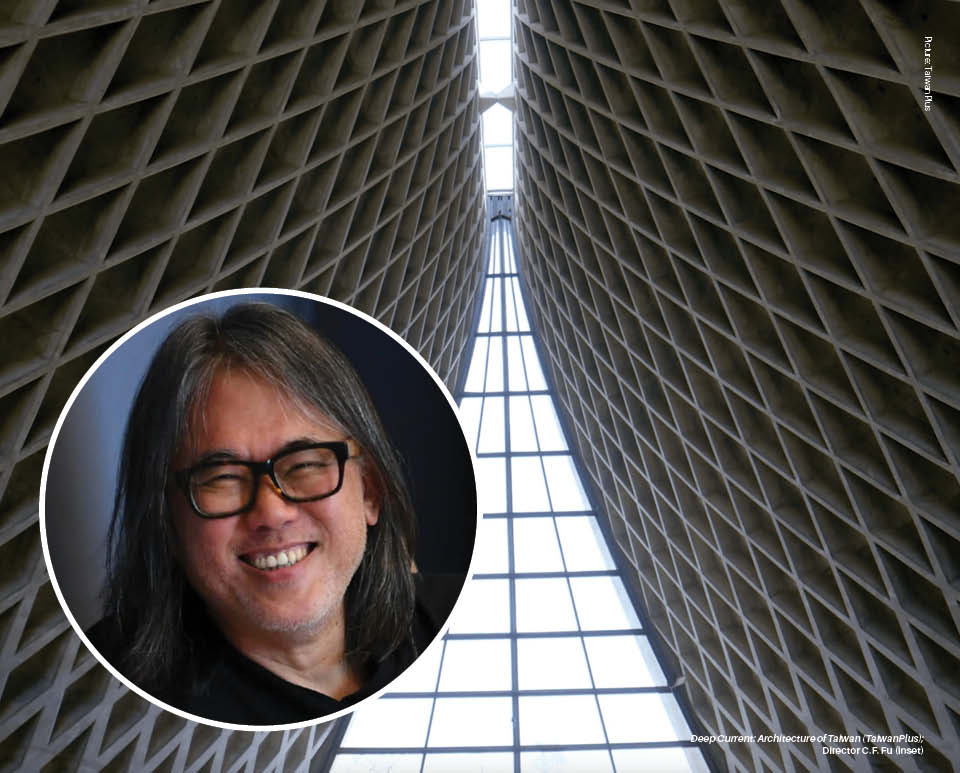
TaiwanPlus factual series, "Deep Current: Architecture of Taiwan" – winner of the ContentAsia Awards 2025 Best Factual Programme Made in Asia for Multiple Asian and/or International Markets category – is an eight-episode docuseries tracing the fusion of history and global influences on Taiwan’s architecture. The winning episode – "Missionaries’ New World" – explores the impact of Protestant and Catholic missions, from European missionaries to the visionary works of I. M. Pei and Japan’s Kenzo Tange, all of who left lasting footprints on Taiwan’s landscape. We spoke to director C.F.Fu about the series...
Where did the idea come from? “As a filmmaker, I’ve always felt that architecture quietly shapes our lives. Buildings stand there longer than we do. Even if they’re not permanent, they outlast individual lifetimes. Taiwan’s geography is unique – positioned between the Asian continent and the Pacific. Different cultures have passed through, settled, ruled, and built here. Each era left physical traces. When we ask, ‘What is Taiwan’s cultural identity?’ we’re really confronting something fluid and evolving. In the series, I think of it like the Kuroshio Current flowing past the island – constantly moving, yet deeply defining. That became an important metaphor for us.”
Were there surprises during research? For example, the story about asking the gods for help building Luce Memorial Chapel. “That story is wonderful. Luce Memorial Chapel at Tunghai University was completed in 1963, at a time when structural expressionism were part of a global architectural movement. You can trace connections back to Le Corbusier’s Philips Pavilion in Brussels in 1958, and later to I. M. Pei’s design for the chapel. As Kou &Su emphasizes, The Luce Memorial Chapel is a hybrid rib-shell system rather than a thin-shell structure. Defined by four curved concrete walls supported by internal ribs, its construction is more robust and conservative. This structural weight, however, is instrumental in achieving the chapel's distinctive human scale. By contrast...
TaiwanPlus factual series, "Deep Current: Architecture of Taiwan" – winner of the ContentAsia Awards 2025 Best Factual Programme Made in Asia for Multiple Asian and/or International Markets category – is an eight-episode docuseries tracing the fusion of history and global influences on Taiwan’s architecture. The winning episode – "Missionaries’ New World" – explores the impact of Protestant and Catholic missions, from European missionaries to the visionary works of I. M. Pei and Japan’s Kenzo Tange, all of who left lasting footprints on Taiwan’s landscape. We spoke to director C.F.Fu about the series...
Where did the idea come from? “As a filmmaker, I’ve always felt that architecture quietly shapes our lives. Buildings stand there longer than we do. Even if they’re not permanent, they outlast individual lifetimes. Taiwan’s geography is unique – positioned between the Asian continent and the Pacific. Different cultures have passed through, settled, ruled, and built here. Each era left physical traces. When we ask, ‘What is Taiwan’s cultural identity?’ we’re really confronting something fluid and evolving. In the series, I think of it like the Kuroshio Current flowing past the island – constantly moving, yet deeply defining. That became an important metaphor for us.”
Were there surprises during research? For example, the story about asking the gods for help building Luce Memorial Chapel. “That story is wonderful. Luce Memorial Chapel at Tunghai University was completed in 1963, at a time when structural expressionism were part of a global architectural movement. You can trace connections back to Le Corbusier’s Philips Pavilion in Brussels in 1958, and later to I. M. Pei’s design for the chapel. As Kou &Su emphasizes, The Luce Memorial Chapel is a hybrid rib-shell system rather than a thin-shell structure. Defined by four curved concrete walls supported by internal ribs, its construction is more robust and conservative. This structural weight, however, is instrumental in achieving the chapel's distinctive human scale. By contrast, the Luce Memorial Chapel is a hybrid system composed of four curved reinforced-concrete walls combined with rib supports. Its massive and relatively conservative construction reflects the realities of construction technology and material conditions in Taiwan during the 1960s, and also reveals the absence of a highly industrialized engineering system at the time. However, its significance lies not in structural efficiency, but in the symbolic power generated through the visualization of structure: the converging curved surfaces rise toward the sky, allowing concrete to become a shared language of faith and modernity. Within the Cold War campus context, this exposed structure symbolizes rational civilization while simultaneously carrying spiritual redemption. Thus, the Luce Memorial Chapel belongs to the lineage of postwar structural expressionism, while also embodying Taiwan’s cultural response under technological constraints—a translated form of modernity. But in postwar Taiwan, building something that technically ambitious was extraordinary. Resources were limited, construction technology was still developing. So the idea that someone might ask the gods for advice — it reflects something uniquely Taiwanese. Of course, the chapel has stood for nearly seventy years. It was built with rigor and care. But it’s such a striking structure that it invites these stories.”
How deliberate was the framing of interviews? “Very little is staged. When I meet someone, I immediately respond to their personality – how they speak, how they carry themselves. That instinct guides where I place the camera. Then the architecture itself – the light, the scale of the space – determines the rest. I don’t over-design interviews. These are architects and scholars, not actors. If it feels too arranged, it loses authenticity.”
Was it difficult to gather archival material? “We were fortunate. Professor Chaolee Kuo, who served as screenwriter, has devoted his life to architectural research and criticism. His expertise shaped the historical framework and helped us access both materials and key voices. It was a deeply collaborative process.”
How did you decide the order of churches in the episode? “Architecture is always connected to power – religious, political, or economic. So I asked: What does architecture born from simple faith look like? Where does belief become space? Interestingly, many Catholic missionaries who arrived in Taiwan after 1949 chose to build in Taitung, on the island’s less developed east coast – far from political centers. There, they created more than forty modernist churches. Some were designed by major European architects, including Justus Dahinden and Gottfried Böhm. These are remarkable works of modernism, yet many people in Taiwan barely know they exist. So the sequence reflects both geography and philosophy – from margins to centers, from belief to form.”
Did you exclude anything because the audience is international? “No. I believe Taiwanese architecture makes the most sense when viewed within the global movement of 20th-century modernity. When you frame it within that larger context, it becomes accessible – not local, but part of a shared architectural history.”
Was it difficult to find interviewees? “Not particularly. Both Professor Kuo and producer Victor Su are highly respected in Taiwan’s architectural community. Their credibility helped bring many important voices into the series.”
What about sound design? “For me, sound is equal to image. Each musical choice connects to a specific historical atmosphere or emotional landscape. Sound carries memory. It deepens how architecture is experienced.”
Was the music original? Yes, entirely Composer Alex Lin and I have collaborated for over 20 years. In fact, sound often comes before image in my process. We discuss tone, texture, instrumentation — sometimes even before filming begins.”
How long did the project take? “From initial conversations to final post-production, nearly four years. We spent over a year just discussing ideas, without a fixed format. Then we circled the island twice identifying locations and interview subjects. Filming, editing, sound design — it was a long, evolving journey.”
Where did the final quote for the winning episode – “On this land of many gods, may the integration of different ethnic groups be a beautiful reality, not just a dream”– come from? “That line was spoken spontaneously by Professor Kuo after editing was complete. It felt honest and vivid — so we kept it.”
What do you hope audiences take away? “The series began with simple questions – who are we, and how do we live within history? Taiwan is a place where histories overlap – migration, belief, colonisation, modernity. Each layer leaves traces, and those traces become architecture. Today, as Taiwan continues to define itself in a changing world, these buildings feel almost like quiet witnesses. They have stood through transitions, through uncertainty, through renewal. Architecture belongs to everyone. It holds memory, but it also holds possibility. I hope audiences can sense that tension – between what has been built, and what is still becoming. series began with simple questions — who are we, and how do we live within history?”
An edited version of this interview appeared in ContentAsia's eNewsletter (9 March 2026)
Previous

Next