






FEATURES

ContentAsia Awards Focus: Making the Numbers Work with ABC TV Japan’s “Miracle 100” Producer Satoshi Shiba
04 May 2026
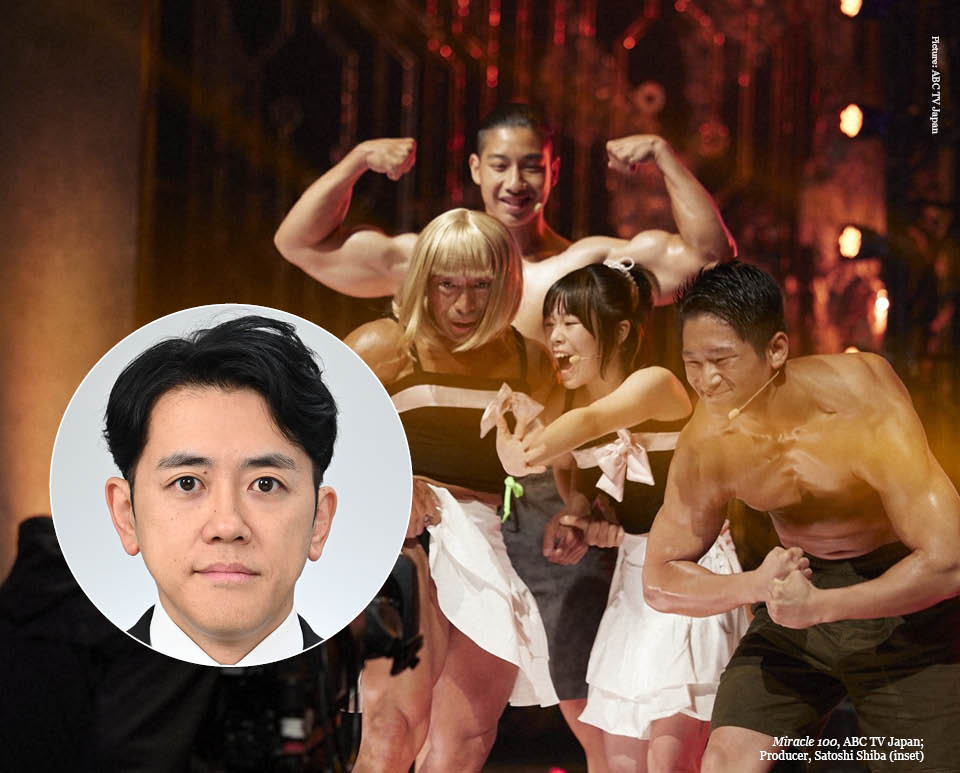
ABC TV Japan’s entertainment show "Miracle 100" – winner of the ContentAsia Award 2025 for Best Factual Entertainment Programme Made in Asia for Multiple Asian and/or International Markets as well as the award for Best Variety Programme – is a multi-generational singing gameshow where teams of amateur and celebrity performers must have a combined age of exactly 100, and aim to score a perfect 100 from the audience and panel. We spoke to ABC TV producer, Satoshi Shiba, about making the numbers work.
What’s the trick to finding groups that make up exactly “100”? The first key was broad and creative research. We looked widely for distinctive people, relationships and backstories that could lead us to memorable combinations. The second was careful and persistent communication. In some cases, contestants themselves became part of the process of completing the group. For example, one contestant was a late-blooming idol chasing what she felt might be her last shot, and she worked very hard herself to find the right partner. For us, it was never enough that a group simply added up to 100 numerically. We wanted groups that also felt emotionally right for the format.
There was a case where a dog was included to make the total reach 100… The dog combination felt genuinely surprising, charming and fun. We also considered other possibilities, such as babies. So yes, that kind of flexibility definitely helped broaden the casting possibilities. At the same time, we were very careful not to let the concept become too loose or feel like “anything goes”.
How many people did you look at before finding the ideal combinations? That was one of the biggest challenges. We were not simply looking for strong singers or performers. We were looking for groups with real story value – groups where you could feel the bond, the history and the connection between the members. We also wanted variety across the line-up. We considered around five times as many groups as those who eventually appeared in the programme.
How did the creative partnership between Japan, Korea and Singapore shape the final format? The original idea came from our Korean partner, but we felt strongly that we needed to answer one important question: w...
ABC TV Japan’s entertainment show "Miracle 100" – winner of the ContentAsia Award 2025 for Best Factual Entertainment Programme Made in Asia for Multiple Asian and/or International Markets as well as the award for Best Variety Programme – is a multi-generational singing gameshow where teams of amateur and celebrity performers must have a combined age of exactly 100, and aim to score a perfect 100 from the audience and panel. We spoke to ABC TV producer, Satoshi Shiba, about making the numbers work.
What’s the trick to finding groups that make up exactly “100”? The first key was broad and creative research. We looked widely for distinctive people, relationships and backstories that could lead us to memorable combinations. The second was careful and persistent communication. In some cases, contestants themselves became part of the process of completing the group. For example, one contestant was a late-blooming idol chasing what she felt might be her last shot, and she worked very hard herself to find the right partner. For us, it was never enough that a group simply added up to 100 numerically. We wanted groups that also felt emotionally right for the format.
There was a case where a dog was included to make the total reach 100… The dog combination felt genuinely surprising, charming and fun. We also considered other possibilities, such as babies. So yes, that kind of flexibility definitely helped broaden the casting possibilities. At the same time, we were very careful not to let the concept become too loose or feel like “anything goes”.
How many people did you look at before finding the ideal combinations? That was one of the biggest challenges. We were not simply looking for strong singers or performers. We were looking for groups with real story value – groups where you could feel the bond, the history and the connection between the members. We also wanted variety across the line-up. We considered around five times as many groups as those who eventually appeared in the programme.
How did the creative partnership between Japan, Korea and Singapore shape the final format? The original idea came from our Korean partner, but we felt strongly that we needed to answer one important question: why 100? That same point was also raised by our Singaporean partner. Through conversations, we developed a stronger thematic interpretation of the format: this is a once-in-a-lifetime competition, where the same combination of people can only ever appear once, and where that uniqueness creates what we saw as a kind of festival of miracles. That became the conceptual heart of the ABC TV version.
The original title is 100, while the Japanese ABC TV version was produced as Miracle 100. What was the reasoning behind adding “Miracle”? For us, the word “Miracle” expressed the deeper meaning we wanted to give the show. We did not want it to feel like a concept driven only by numbers. We wanted it to feel like a unique celebration – a special event created by unrepeatable combinations of people, stories and relationships. “Miracle” captured that idea, so it became part of the title in Japan.
The format also calls for 100 jurors. How difficult was it to manage this many jurors? One of the practical challenges was that the score differences between performances were often narrower than expected, which made it more difficult to create clear contrast. At the same time, every contestant came with a meaningful story, so we wanted to avoid creating a judging atmosphere that felt unnecessarily harsh. We did not want participants who had worked hard and prepared seriously to leave feeling discouraged, even if they did not win. We wanted it to be the kind of competition where people could still feel, “I’m glad I was part of this”.
Adapted from the original version of this article, published on ContentAsia’s dedicated Awards platform on 27 April 2026. Access ContentAsia Awards Focus here
Previous

Next