






FEATURES

“How Much Value Can We Add?”, Asks Utopai Studios’ New APAC President Hyun Park
06 October 2026
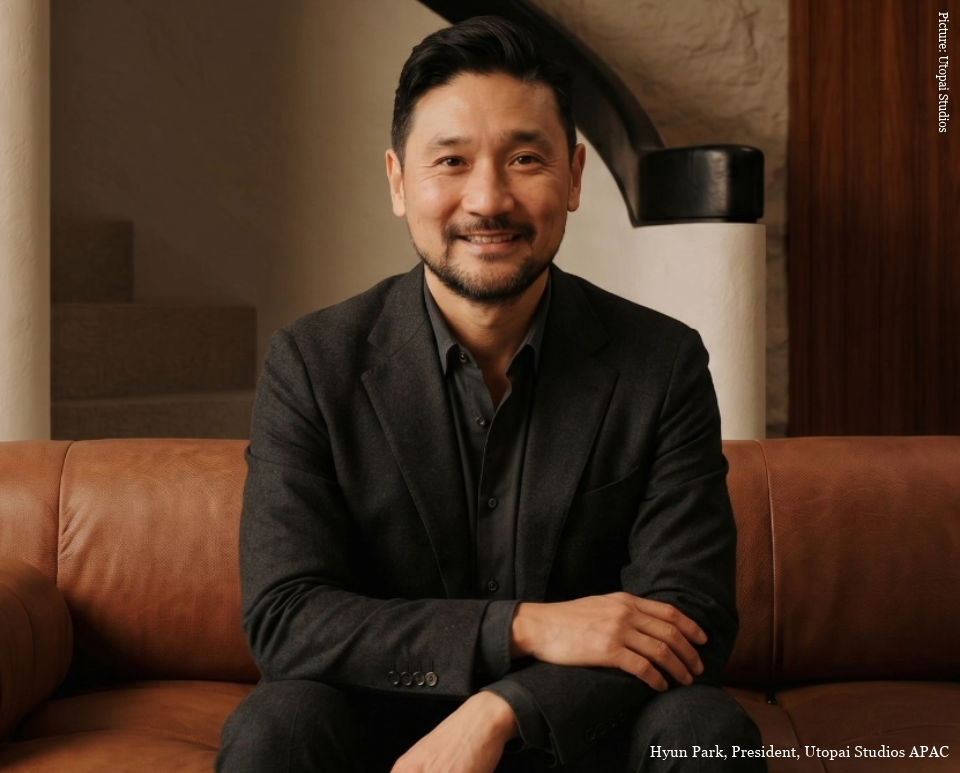
Utopai Studios’ new APAC president, Hyun Park, talks about budgets, backing and the fledgling studio’s plans for Asia.
Hyun Park is betting – safely in our opinion – that a US$1-million Indonesian movie has a much better chance globally if it looks like a US$10-million movie. But that’s a bit further down the road for the newly appointed APAC president of Utopai Studios. For now, and for a fledgling AI company running faster than its legs can carry it, Korea and Japan are Targets #1 and #2.
Perhaps best known for his early involvement in Korean streaming platform DramaFever in 2009 as well as stints at SoftBank and CJ ENM’s Studio Dragon, Park was appointed to the new Utopai Studios role in August this year. This followed Utopai’s acquisition of his Seoul-based production house Alquimista Media in early 2026.
The integration consolidates Utopai’s Korea-Japan venture into a single regional operation with more than 18 film and television projects in the pipeline of a total 25 titles in development. First titles are due for release in 2027.
There’s no single approach to projects and no template to impose. The highest-profile Asia-linked projects announced so far include financial backing for “Half Moon” live-action co-production between Germany and Korea, and a fully AI-generated “Journey to the West” series with China’s Huace. There’s also the U.S. animated movie adaptation of Mike Bender’s children’s book, “The Most Serious Fart”.
“For us it’s great to be able to come in and say not only do we have the agentic workflows to help you reduce costs in production, we have the development team to help you craft the scripts, we also can come in with skin in the game and invest in your movies. That’s a powerful message in these times when liquidity is an issue,” he says, adding: “We have so many things going on at such different levels, different levels of investment, different levels of involvement from our company.”
Korea, Park explains, is the natural proving ground for the AI-powered model. If, in Hollywood, AI still splits the industry 50/50 – “50% of people love to t...
Utopai Studios’ new APAC president, Hyun Park, talks about budgets, backing and the fledgling studio’s plans for Asia.
Hyun Park is betting – safely in our opinion – that a US$1-million Indonesian movie has a much better chance globally if it looks like a US$10-million movie. But that’s a bit further down the road for the newly appointed APAC president of Utopai Studios. For now, and for a fledgling AI company running faster than its legs can carry it, Korea and Japan are Targets #1 and #2.
Perhaps best known for his early involvement in Korean streaming platform DramaFever in 2009 as well as stints at SoftBank and CJ ENM’s Studio Dragon, Park was appointed to the new Utopai Studios role in August this year. This followed Utopai’s acquisition of his Seoul-based production house Alquimista Media in early 2026.
The integration consolidates Utopai’s Korea-Japan venture into a single regional operation with more than 18 film and television projects in the pipeline of a total 25 titles in development. First titles are due for release in 2027.
There’s no single approach to projects and no template to impose. The highest-profile Asia-linked projects announced so far include financial backing for “Half Moon” live-action co-production between Germany and Korea, and a fully AI-generated “Journey to the West” series with China’s Huace. There’s also the U.S. animated movie adaptation of Mike Bender’s children’s book, “The Most Serious Fart”.
“For us it’s great to be able to come in and say not only do we have the agentic workflows to help you reduce costs in production, we have the development team to help you craft the scripts, we also can come in with skin in the game and invest in your movies. That’s a powerful message in these times when liquidity is an issue,” he says, adding: “We have so many things going on at such different levels, different levels of investment, different levels of involvement from our company.”
Korea, Park explains, is the natural proving ground for the AI-powered model. If, in Hollywood, AI still splits the industry 50/50 – “50% of people love to talk about it, 50% will not want to hear about it” – Korea is the market “where you have this combination of great IP, great creative talent”. More importantly, Park says, “we’re talking to top directors in Korea, top writers in Korea, they’re all using AI now.”
Park is open about AI’s current limitations, and acknowledges that the technology doesn’t suit every director. His goal is simple: “How we can use AI to enhance productivity, shorten production schedules, lower budgets, and make better content.”
Japan’s take on the tech is more cautious, shifting from blunt refusal six or so months ago to growing acceptance of the inevitable.
“Animation companies now all have their AI teams... They see that there aren’t enough resources to produce content at the massive scale that global markets are now asking for, and AI becomes a great additional tool to create animation.” In early September, Utopai Studios unveiled an AI-assisted animation collaboration with Japanese tech company DeNA.
If outcomes are not settled yet, conversations are well underway. “For us, it’s mostly like, ‘let’s start doing something together’. And then we’ll decide how far we can go.”
Southeast Asia – including Vietnam, Indonesia and Malaysia – and beyond remain on the horizon. “Can we help big media companies that don’t have the tech resources to create a production AI workflow to help them create better content faster? A million-dollar movie in Indonesia could look like a $10 million movie, right?” Park explains.
Talks in Southeast Asia so far are tech-based, with expectations that creative conversations will follow to support long-form premium content. Continuity is important; “we aren’t doing shorts or social media originals at great scale,” Park says.
For Utopai Studios, the biggest question is: “How much value can we add, and where should we spend our resources?”
Park’s own involvement with AI – and his subsequent tie-up with Utopai – comes on the back of soaring costs of premium production and shrinking distribution options. The question for his company – Alquimista Media, set up in Seoul in early 2025 – then became: “How can we ensure the creative vision of our talent without lowering the bar on production quality?”
Published in ContentAsia's Oct/Nov 2026 Magazine
Previous

Next