






FEATURES

The Long & the Short: Indonesian Streaming Powerhouse Vidio Customises its Vertical Video Strategy
06 October 2026
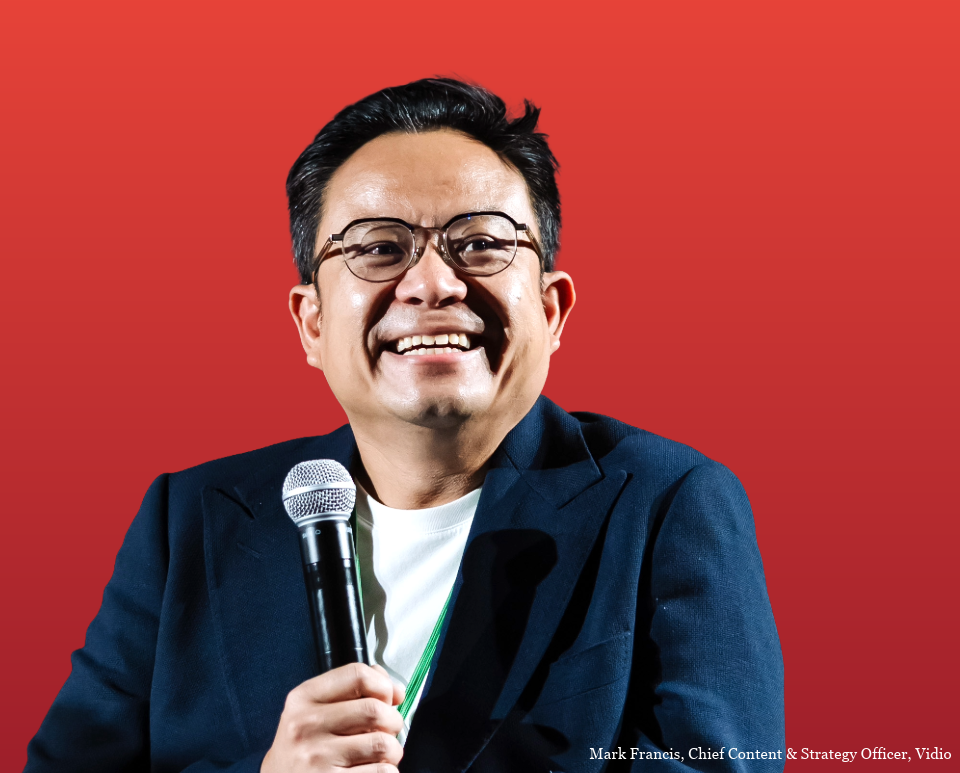
Indonesian streaming platform Vidio has opened its doors to a new customised vertical video environment in partnership with microdrama app ReelShort. Chief content and strategy officer Mark Francis talks about the one-of-a-kind approach.
The question for Vidio’s chief content and strategy officer, Mark Francis, was never whether to add short-drama to the Indonesian streaming platform. Rather, his issue was always how to integrate the new format into the entertainment offering, including where the collection of vertical series would live within the existing interface. By the end of August this year, enough boxes had been ticked on the vertical video bet, and Vidio pressed start on its landmark acquisition and production partnership with global microdrama app ReelShort.
The deal – ReelShort’s first of its kind in Indonesia – is a significant departure from the data-bundled distribution alliances that the Crazy Maple Studios-owned app has forged with telco partners. The approach avoids replicating the offering from pure-play microdrama apps while still fulfilling corporate revenue dreams and growth wishes.
Vidio CEO Sutanto Hartono says that boosting short drama is in line with the changing ways Indonesians consume content. The country has emerged as Asia-Pacific’s largest market for short-form drama consumption, accounting for 39% of the region’s total audience, according to Media Partners Asia (MPA).
“As audiences increasingly look for content that fits seamlessly into their daily lives, we want to ensure they can find every type of entertainment they love on a single platform, from live sports, local originals, global entertainment to now, the rapidly growing format of short dramas,” Hartono says.
He enters the microdrama space in pole position and with a lot to protect. The MPA/ampd report, “Online Video Consumer Insights: Southeast Asia Q2 2026”, shows Vidio holds the largest share of Indonesia’s SVOD subscriptions at 20.7%. In Q2 2026, Vidio reached 5.8 million paid subscribers across Southeast Asia, ranking third regionally.
Vidio’s ReelShort agreement involves vertical drama acquisitions as well as co-productions involving Indonesian production houses and talent. The co-productions will play on both Vidio in Indonesia and ReelShort globally.
The first ReelShort titles launched on Vidio on 1 September in a dedicated short drama tab hard-baked into existing premium subscription packs.
More than 200 titles across a range of genres including romance, billionaire romance, fantasy, and family drama series, were fully dubbed in Bahasa Indonesia in the initial rollout, with co-productions to follo...
Indonesian streaming platform Vidio has opened its doors to a new customised vertical video environment in partnership with microdrama app ReelShort. Chief content and strategy officer Mark Francis talks about the one-of-a-kind approach.
The question for Vidio’s chief content and strategy officer, Mark Francis, was never whether to add short-drama to the Indonesian streaming platform. Rather, his issue was always how to integrate the new format into the entertainment offering, including where the collection of vertical series would live within the existing interface. By the end of August this year, enough boxes had been ticked on the vertical video bet, and Vidio pressed start on its landmark acquisition and production partnership with global microdrama app ReelShort.
The deal – ReelShort’s first of its kind in Indonesia – is a significant departure from the data-bundled distribution alliances that the Crazy Maple Studios-owned app has forged with telco partners. The approach avoids replicating the offering from pure-play microdrama apps while still fulfilling corporate revenue dreams and growth wishes.
Vidio CEO Sutanto Hartono says that boosting short drama is in line with the changing ways Indonesians consume content. The country has emerged as Asia-Pacific’s largest market for short-form drama consumption, accounting for 39% of the region’s total audience, according to Media Partners Asia (MPA).
“As audiences increasingly look for content that fits seamlessly into their daily lives, we want to ensure they can find every type of entertainment they love on a single platform, from live sports, local originals, global entertainment to now, the rapidly growing format of short dramas,” Hartono says.
He enters the microdrama space in pole position and with a lot to protect. The MPA/ampd report, “Online Video Consumer Insights: Southeast Asia Q2 2026”, shows Vidio holds the largest share of Indonesia’s SVOD subscriptions at 20.7%. In Q2 2026, Vidio reached 5.8 million paid subscribers across Southeast Asia, ranking third regionally.
Vidio’s ReelShort agreement involves vertical drama acquisitions as well as co-productions involving Indonesian production houses and talent. The co-productions will play on both Vidio in Indonesia and ReelShort globally.
The first ReelShort titles launched on Vidio on 1 September in a dedicated short drama tab hard-baked into existing premium subscription packs.
More than 200 titles across a range of genres including romance, billionaire romance, fantasy, and family drama series, were fully dubbed in Bahasa Indonesia in the initial rollout, with co-productions to follow that will stream across both Vidio and ReelShort globally.
Vidio said the partnership combined global content scale, local production capabilities, skill transfer, and deeper localisation, reinforcing its position as a platform for the next generation of entertainment in Indonesia.
The collaboration also creates opportunities for Indonesian creative talent to gain production expertise and knowledge from ReelShort’s global short-drama experience, the platform said.
In a wide-ranging interview with ContentAsia, Francis talked about Vidio’s multiple efforts to customise a vertical video strategy, about experimenting with production and pricing, and about finding “a third space” that allows all parties to “triple-dip on revenue”.
You were considering the ReelShort deal for more than a year. What took so long?
“Definitely more than a year... It’s taken some doing, but this wasn’t our first attempt at microdrama. We’d already launched around 30 acquired titles and started producing our own originals, but that was very much a deliberate experimentation phase. We tried everything, sachet pricing, rewarded ads, and it felt like something else needed to happen.
“About six or seven months ago we went in with a different hypothesis. If you look at the unit economics of microdrama, the full-blown apps are really competing amongst themselves, and we don’t think Vidio is one of those.
Vidio is both mobile and big screen, and we’re the largest platform in Indonesia. A lot of our users already consume different formats on mobile, so the question was never really if, it was how. We believe ReelShort represents the way we want to enter.”
Walk us through your microdrama deal with ReelShort.
“First and foremost, it’s a very robust output deal. ReelShort is doing deals everywhere, but I wouldn’t say, compared to some others, that they’re a full-blown distributor yet. They still run direct-to-consumer, including their own app in Indonesia, and they’ll keep pursuing telco partnerships.
“We think there’s a third space that doesn’t necessarily cannibalise either of those and hopefully lets all parties triple-dip on revenue: injecting a meaningful amount of good microdrama into an ecosystem that already has quality engagement around local content and other formats. We believe that’s Vidio.
“To do that, we needed ReelShort to take a leap of faith with us. Our launch commitment is around 30,000 episodes. From day one we’ll have 100 titles available, on top of the library of existing microdrama we already carry, and we’ll build from there.
“Just as important is the co-production piece. We’re not disclosing the exact number of co-productions, but it’s not insignificant. We’ll take their IP and formats and adapt these into Bahasa Indonesia using Emtek’s production infrastructure, which is actually a longer-term strategic goal for our group too. Vidio is part of [listed media conglomerate] Emtek, which also owns TV channels and studios, so we have access to a lot of stars and soap opera writers whose tropes aren’t that different from microdrama.”
You also have access to about 5.8 million paying subscribers and a much larger number of monthly active users (MAUs) on Vidio’s free tier...
“Microdrama apps reportedly spend as much as 80% of their budget on marketing. What if you didn’t have to? What if, instead, those titles can be marketed to that audience more organically and efficiently? That’s where you start to see different efficiencies.”
Are you charging extra – or a separate subscription – for microdramas?
“Not specifically. There’s no bundle to buy, it’s part of the platform, a value-add, for now. Never say never, but right now it’s built into the existing subscription. Users get an extra service without paying more.”
Where does microdrama fit into Vidio’s broader content strategy?
“I’ve always described Vidio as a content buffet. There are three core pillars: live local and international sports, premium original series (about 10 to 12 of those a year), and investment in Indonesian film. Then there’s local TV. Local TV isn’t where the wallet is, but it’s absolutely where the taste is: a lot of our engagement and minutes rely on it. Looking forward, quality engagement, appointment viewing and live content, whether that’s an entertainment format or live sport, is going to matter more and more. This is about being relevant to our users on every screen, at all times. That’s really what’s behind this deal. There’s another feature in the works too... to optimise how microdrama is presented on big screen TV. It might sound counterintuitive, but a lot of people already watch vertical content from YouTube on their TVs without really noticing. That convergence between mobile and big screen is something we want to be ahead of.”
What have you changed about the user experience, based on your first attempt at microdrama?
“The same old lesson holds: the medium is the message. Every format is slightly different, and audiences are far more fragmented and segmented than we like to admit because that doesn’t fit neatly into quarterly reports. Our job is to find niches large enough to be worth serving. That was one of the first things I focused on when I joined Vidio three years ago. If you look at the whole map of Vidio’s user base, there are so many different segments. How do you serve all of them well, in one place that’s understandable and easy to navigate?
“With microdrama specifically, I felt there was no way we could go head to head with the pure-play apps. A lot of those were born out of taking individual pieces of popular web novel content and putting them into WeChat, generating billions of clicks. That format doesn’t necessarily translate to a platform like Vidio, which is built around curated, long-form IP.
“So the lesson was to think not just about the content, but the context in which it’s consumed, because mobile and big screen use is going to keep diverging. You can already see that with the big premium streamers... which are mostly built for the big screen but are now also launching microdrama and vertical formats for discovery, which makes a lot of sense. Our answer was to build it ourselves, from day one, through local production and meaningful partnerships.
“What we’re building is a way to present and curate thousands of episodes on the mobile homepage. You’ll see a short drama rail next to the live button. That’s really the beginning of what I think of as Vidio Vertical. There may be more formats than just short drama to come. We’re also seeing behaviour where users who engage with this content on mobile give us great retention, low churn and high lifetime value once they move to the big screen.
“There’s a world where a piece of IP starts as a microdrama and later extends into something long-form. Creatively, with generative AI in the mix too, that opens up a lot of possible formats. That’s really where we need to focus.
“On localisation, we’ve committed to fully dubbing more than 200 titles at launch. We can’t chase down everything we need to know all at once, so dubbing lets us move quickly and take it from there.”
On the co-production side, will you only adapt ReelShort IP, or develop your own as well?
“We’re pretty open. Early on, we didn’t overthink it, we just tried a bunch of things. Looking back, it was very early days. We didn’t fully appreciate how much the algorithm was driving the storytelling, and we didn’t lean into copying a proven format outright.
“Going forward, our assumption is that unless you follow the rhythm and story hooks the data tells you work, the content will probably suffer. So our next phase is about relying more on proven formats for structure. We may still adapt them to a degree, and then choose the themes and subjects with the best chance of working.”
Who decides what gets adapted?
“Broadly, we look at two things: revenue and engagement. Were these titles the ones that paying subscribers were willing to pay to unlock behind a paywall? And engagement: how many people watched, how long, how interested were they? If a title already over-indexes in an Indonesian context, that can raise the question of whether an adaptation would even add anything, but we don’t focus on the unknowable. We just treat that as a good starting point: the top-performing titles in that space.”
If a title is already a top performer among Indonesian audiences, doesn’t that mean people already know the story?
“I don’t think everyone does, and that’s the point of Vidio. A title might be the top microdrama title in Indonesia among ReelShort’s existing users, but there are still 15 million to 17 million people on Vidio who’ve never seen it.
“We’re not here to serve the microdrama super-user first. We’re not trying to fight for the viewer who’ll spend on rewarded ads or sachet payments, that’s not our space. We want to bring the most relevant, popular content, in a format that’s clearly working, to an existing base of Vidio users who already watch soap opera and other formats.
“What I’ve found is that more is sometimes more, it can lift engagement across the board. Add something that was missing, and more people show up. That’s the whole idea behind the buffet.”
Looking at your launch marketing material, most of the lead titles feature Western, largely white, casts, even though a lot of the underlying story data comes from Chinese web novel platforms. Why lean into that?
“We used the top-trending titles at the time we launched the marketing, so there’s some data behind the choice. But it’s true that a lot of the funnel and engagement in this category comes from Mandarin-language programming generally. What drew us to ReelShort specifically is that they have a lot of original, branded content, some AI and generative AI involved too, but by and large they’re closer to being the HBO of microdrama. Their number-one market by revenue is still North America, which is part of why we leaned into a lot of this Western-cast content. If Vidio’s ambition from day one was to be as broad as possible across microdrama generally, that might look like a strange choice, but I don’t think it is. ReelShort is number one by market share and global revenue, so that’s the proof point...
“It’s a fascinating case where the algorithms and tropes that work were largely shaped by Chinese data, even when the companies producing this content are based in L.A. and work with Western casts. This kind of data really turns an assumption on its head. We’ve generally believed people engage more with content featuring people who look like them. But the engagement here, with entirely foreign faces, suggests that might only be part of the story.”
What’s your theory for why it travels anyway?
“I think it’s specific to this genre, the soap. The hyper-dramatisation, the histrionics, that travels. Korean 16-part dramas and rom-coms travel. Turkish soaps travel. Latin American telenovelas travel. Hating your mother-in-law probably translates into a number of languages and cultures.”
When you localise beyond dubbing, what kind of stories do you think will work with local casts and cultural references?
“I think we need to let the data speak for itself here, and resist the urge to lean on 30 years of making shows and assume I already know the answer. At least for now, I don’t want to prejudge what those stories are. People might think they want something, but often the reality is more complicated than that.”
Do you see a future where you broaden local production beyond this deal, co-producing more widely with Thailand, Taiwan or the Philippines?
“Yes, quite possibly soon. You could imagine an IP or a world, say the equivalent of a family dynasty soap, where certain characters or storylines are perfectly suited to a microdrama format, catching a new type of user while still linking them back into the broader universe you’re building. The benefit is that if you complete the ecosystem, you’re building an engagement value chain around that IP across different formats. That has to be a good thing.”
Previous

Next