







FEATURES

“I want people to have fun, not really bother about the message”; Indonesian filmmaker Edwin on horror fantasy feature “Sleep No More”
23 February 2026
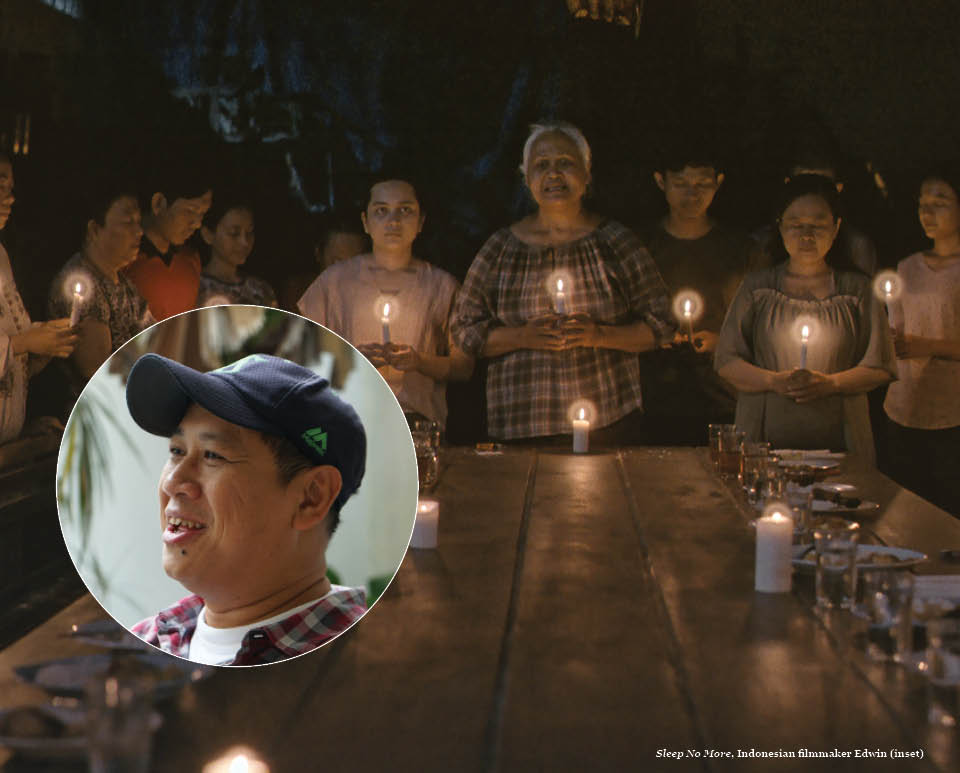
On one hand, Indonesian filmmaker Edwin has delivered a deeply creepy, darkly comic comment on labour, greed and capitalism in his latest film, Sleep No More. On the other, he really wants audiences to have fun with the feature, and not be overly bothered about the message.
“Our world,” he says, “is getting sicker and sicker”. And “it’s not improving; it is becoming normalised to the extent that it turns horrifyingly absurd. People are expected to grow body parts in order to survive long hours of slavery. For what and for whom? To fuel the greedy capitalism machine that only corrupts humanity and the environment. Why are we still doing all of this...”
"Sleep No More" ("Monster Pabrik Rambut"), which premiered on Valentine’s Day at the 76th Berlin International Film Festival, blends horror, dark comedy and surreal fantasy to confront what he sees as the grotesque normalisation of labour exploitation.
“We want to say that labour exploitation and inhuman working conditions are still an everyday reality, at least in my country and, I am sure, in many others,” he says.
A five-country co-production involving Indonesia (Palari Films, Beacon Film), Singapore (Giraffe Pictures), Japan (Hassaku Labs), Germany (In Good Company) and France (Apsara Films), "Sleep No More" is about two sisters in the aftermath of their mother’s sudden death at a wig factory.
Putri (Rachel Amanda) believes it was suicide induced by sleep deprivation. Her sister Ida (Lutesha) has a more sinister theory: demonic possession. When their youngest brother Bona (Iqbaal Ramadhan), born with a gift to regenerate his own body, catches the attention of a ghostly figure roaming the corridors of the factory, the sisters descend into the bowels of the haunted building and unravel the twisted strands of lies and deceit.
"Sleep No More" came on the heels of "Borderless Fog" ("Kabut Berduri", 2024) for Netflix – and a yearning to return to the big screen.
“I kind of missed making something for the cinema,” he told ContentAsia in the run up to the Berlin premiere.
He also wanted to try his ...
On one hand, Indonesian filmmaker Edwin has delivered a deeply creepy, darkly comic comment on labour, greed and capitalism in his latest film, Sleep No More. On the other, he really wants audiences to have fun with the feature, and not be overly bothered about the message.
“Our world,” he says, “is getting sicker and sicker”. And “it’s not improving; it is becoming normalised to the extent that it turns horrifyingly absurd. People are expected to grow body parts in order to survive long hours of slavery. For what and for whom? To fuel the greedy capitalism machine that only corrupts humanity and the environment. Why are we still doing all of this...”
"Sleep No More" ("Monster Pabrik Rambut"), which premiered on Valentine’s Day at the 76th Berlin International Film Festival, blends horror, dark comedy and surreal fantasy to confront what he sees as the grotesque normalisation of labour exploitation.
“We want to say that labour exploitation and inhuman working conditions are still an everyday reality, at least in my country and, I am sure, in many others,” he says.
A five-country co-production involving Indonesia (Palari Films, Beacon Film), Singapore (Giraffe Pictures), Japan (Hassaku Labs), Germany (In Good Company) and France (Apsara Films), "Sleep No More" is about two sisters in the aftermath of their mother’s sudden death at a wig factory.
Putri (Rachel Amanda) believes it was suicide induced by sleep deprivation. Her sister Ida (Lutesha) has a more sinister theory: demonic possession. When their youngest brother Bona (Iqbaal Ramadhan), born with a gift to regenerate his own body, catches the attention of a ghostly figure roaming the corridors of the factory, the sisters descend into the bowels of the haunted building and unravel the twisted strands of lies and deceit.
"Sleep No More" came on the heels of "Borderless Fog" ("Kabut Berduri", 2024) for Netflix – and a yearning to return to the big screen.
“I kind of missed making something for the cinema,” he told ContentAsia in the run up to the Berlin premiere.
He also wanted to try his hand at horror. “Why haven’t I made any horror until now? It was just a matter of time,” he says, mentioning films from the 1980s and early 90s that influenced him as a child, along with a long-held taste for Japanese horror.
"Sleep No More" was co-developed with Indonesian author Eka Kurniawan, his co-writer on Locarno Film Festival winner "Vengeance is Mine, All Others Pay Cash", whom Edwin describes as a “fan of the crazy horror genre”.
“I challenged him; let’s write something directly for cinema, an original story, not an adaptation from a book,” he says. The two talked about “a lot of different styles and horror forms, from the very scary to something silly. I think horror and comedy is also almost the same. It’s a difficult form,” he says.
“We also challenged ourselves not to make horror based on urban legend. Because Indonesia has a lot of ghost urban legend stories, which is very, very fun and interesting. But it’s already much explored in cinema.
“We wanted to make our own creation, a creature movie, which is something new for Indonesian cinema, especially in modern horror films.
“So it’s a fun way to start... quite challenging. We questioned ourselves about fear. What makes us afraid of something?”
Japanese writer Daishi Matsunaga came aboard while Edwin and Eka were going back and forth on the script. “We sent this to Daishi to get some kind of a new perspective, new eye, and then we developed into a different, more interesting direction.”
Looking for fearful moments, Edwin dug into his youth, when he was afraid not to be successful in working. “I was afraid to be jobless. As a young art student... There’s no guarantee after you graduate you will find a good job.”
“We started with the idea of doing anything you can to get money to stay alive.”
Sleep No More’s wig factory setting was part of an urban world – rather than the common rural village setting – created for the film. “It’s contemporary and it’s functional, and automatically we had the idea of a factory”. The setting was inspired by a town in central Java where the whole population works in a wig factory. “They collect real hair to make the wigs. And I was like, that’s quite interesting. And maybe it can be scary when you see piles of hair... intriguing as a visual. Imagine if you work alone in that factory, you know, hairs hanging around. Lifeless but also a living organism.”
Much has been made of the film’s social commentary – an Edwin trademark established with features like "Postcards from the Zoo", "Posesif" and "Vengeance Is Mine, All Others Pay Cash".
Just ahead of Berlinale, Edwin said he was less concerned with the messaging than about his audience having fun watching the film. “I want them to have fun and not really bother about what is it about, what is the statement. I just want them to have fun.”
Previous

Next