FEATURES

Interview: The Singapore International Film Festival’s Jeremy Chua
26 November 2026
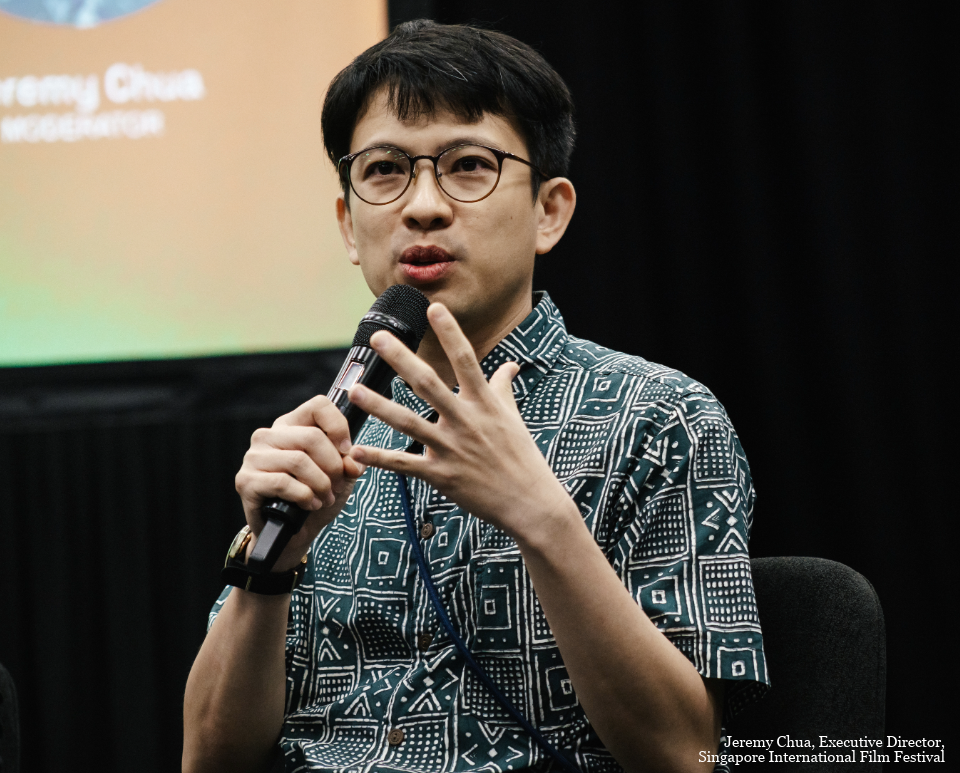
Singapore International Film Festival executive director, Jeremy Chua, talks about films, festivals and Singapore’s place in the creative world order.
When Jeremy Chua decided in 2024 that he’d had enough of struggling as a producer, Singapore lost one of its most able and intuitive names in independent filmmaking. After a prolific decade, Chua was someone who understood how to assemble the international coproductions that made the city’s movie industry pack an outsized punch and whose art-house productions brought acclaim, awards and reflected glory.
Chua and his company Potocol, have credits on more than 30 films, including Indonesia’s 2024 Oscar contender “Autobiography”, Taiwanese sport thriller “Pierce” and dark satire “Filipinana”, which premiered in January with a rare berth at the U.S.-dominated Sundance festival.
Drafted as general manager of the Singapore International Film Festival (SGIFF) in time for its 2025 edition, he was promoted to executive director for 2026, giving him oversight of operations, selection and an expanded industry-support component, SGIFF Pro.
Chua aims to use his skills as a producer to improve the SGIFF.
“When you go to a good festival, you feel like you understand where you are, culturally, where the audience are, how they’re asking questions, what interests them, what resonates with the local politics. And in the halls, you get a sense of what this community is,” he says.
“Competing with festivals in neighbouring places like Hong Kong, Busan or Tokyo would be what we aim for, but we’re not ready for that. Right now, we’re happy to be a meaningful space for a more local demographic.”
Chua says his expanded role has shifted him from a focus on the festival’s behind-the-scenes and structural issues to one increasingly concerned with design elements.
“Audiences in Singapore are not relying on cinema for what it used to mean. Audiences are now much concentrated social gatherings, blockbuster events or fan-meet events,” he says.
“We know that we have a certain kind of audience who are cinephiles who would watch almost anything we throw at them because they trust us, and they’re curious about the world. [Our task] is to slowly enlarge that group by making little tweaks. Lots of tweaks, such as adding a kids-frien...
Singapore International Film Festival executive director, Jeremy Chua, talks about films, festivals and Singapore’s place in the creative world order.
When Jeremy Chua decided in 2024 that he’d had enough of struggling as a producer, Singapore lost one of its most able and intuitive names in independent filmmaking. After a prolific decade, Chua was someone who understood how to assemble the international coproductions that made the city’s movie industry pack an outsized punch and whose art-house productions brought acclaim, awards and reflected glory.
Chua and his company Potocol, have credits on more than 30 films, including Indonesia’s 2024 Oscar contender “Autobiography”, Taiwanese sport thriller “Pierce” and dark satire “Filipinana”, which premiered in January with a rare berth at the U.S.-dominated Sundance festival.
Drafted as general manager of the Singapore International Film Festival (SGIFF) in time for its 2025 edition, he was promoted to executive director for 2026, giving him oversight of operations, selection and an expanded industry-support component, SGIFF Pro.
Chua aims to use his skills as a producer to improve the SGIFF.
“When you go to a good festival, you feel like you understand where you are, culturally, where the audience are, how they’re asking questions, what interests them, what resonates with the local politics. And in the halls, you get a sense of what this community is,” he says.
“Competing with festivals in neighbouring places like Hong Kong, Busan or Tokyo would be what we aim for, but we’re not ready for that. Right now, we’re happy to be a meaningful space for a more local demographic.”
Chua says his expanded role has shifted him from a focus on the festival’s behind-the-scenes and structural issues to one increasingly concerned with design elements.
“Audiences in Singapore are not relying on cinema for what it used to mean. Audiences are now much concentrated social gatherings, blockbuster events or fan-meet events,” he says.
“We know that we have a certain kind of audience who are cinephiles who would watch almost anything we throw at them because they trust us, and they’re curious about the world. [Our task] is to slowly enlarge that group by making little tweaks. Lots of tweaks, such as adding a kids-friendly programme that is about more than screenings, it also has workshops and games [and similarly] our live performances that include sound, puppetry and game engines.”
Much of Chua’s time is spent interfacing with government, which is simultaneously industry regulator, festival financier and taskmaster. He describes the government as both “aspirational” and hidebound.
“If we prove that we can generate and move economics within this artistic space, [government] is ready to go in. They’re not allergic to great ambitions. The problem is that they are hyper-conservative, not in terms of censorship, but in terms of how they manage money. It’s always about three-to-five-year plans, having a proper cycle to get from point A to point B. So, my mission is to prove that point A is solid, stable and does exist and that there’s much potential to expand.”
Fresh out of film school, Chua got his start as a producer when the entrepreneurial father of a friend provided startup cash for a company. Chua and the friend put all of it into “A Lullaby to the Soulful Mystery”, a historical drama by Filipino icon of slow cinema, Lav Diaz.
The film weighed in at eight hours, and was the first Diaz movie selected for main competition at one of the world’s big three film festivals, and won the Silver Bear, second prize, at Berlin in 2016. As a result, other industry players assumed that Chua had a secret recipe for accessing European festivals and other opportunities followed.
“Lullaby” also gave Chua his first taste of Singapore’s committee-style decision-making. He had sought co-production support for the film from Singapore’s Infocomm Media Development Authority (IMDA), but he was turned down.
The IMDA later made up for its error by getting on board the Southeast Asian co-production efforts of Chua and a handful of Singapore producers.
The following eight years of ‘Made With Singapore’ policy gave Chua plentiful insights into distribution, exhibition, festival strategy and the pitifully weak negotiating position of Asia’s indie film producers.
“Producers are at the bottom of the food chain. They have the most liabilities, the most risk and yet they are expected to make the most of both the business side and the creative side. It means a lot of compromises,” he says.
The IMDA, again, was a key factor in Chua’s decision to quit producing, when in 2023, its approach to film funding changed.
“The films that they started to support were the more commercial ones. They cared a lot about box office. I don’t think it’s a right or wrong thing because ultimately a commission has its own KPIs and this is public money,” Chua says. But he worries that such risk-averse decision-making fails to provide long-term support for genuinely creative talent.
“Now I’m inside an institution, I have the capacity to call people out for stupid decision-making, which I could not as a producer making funding applications,” says Chua.
“A lot of commissions in Asia, are not run by creative people. They are pressurised by KPIs or because they want a promotion. They’re not really there to develop an industry. And when a film fails, [they don’t understand] because all the boxes had been ticked. What they don’t recognise is that artistic development and creation is never about concrete outcomes. It’s always about rolling the dice. Even Wong Kar-wai can have a bad film.”
Because of the financial, cultural and media forces at play, film festivals are inherently political and prone to controversies.
This year saw the SGIFF on the receiving end of intense factional lobbying from Korea against the festival’s opening gala presentation, “Assassin(s)”.
“The opening film was not meant to be a statement on our part,” Chua says. “We selected it because we thought it was engaging, entertaining, a good statement piece of art, could fill a big venue like Marina Bay Sands and attract a strong crowd of celebrities and directors.”
“But Singapore is so sensitive to controversy. There’s a fear of almost everything. Order is something that is not only encouraged, it is the de facto mode of operation,” says Chua, who had to explain to authorities that some parts of society welcome dialogue about issues. He held his ground and the screening was allowed to go ahead.
“The festival’s role,” he says, “is to make chaos that is respectable to a certain degree”.
Published in ContentAsia's December 2026 Magazine
Previous

Next