







NEWS

Malaysia, Philippines, Indonesia lift Grok block; MCMC puts X on a short leash, promises close monitoring
26 January 2026
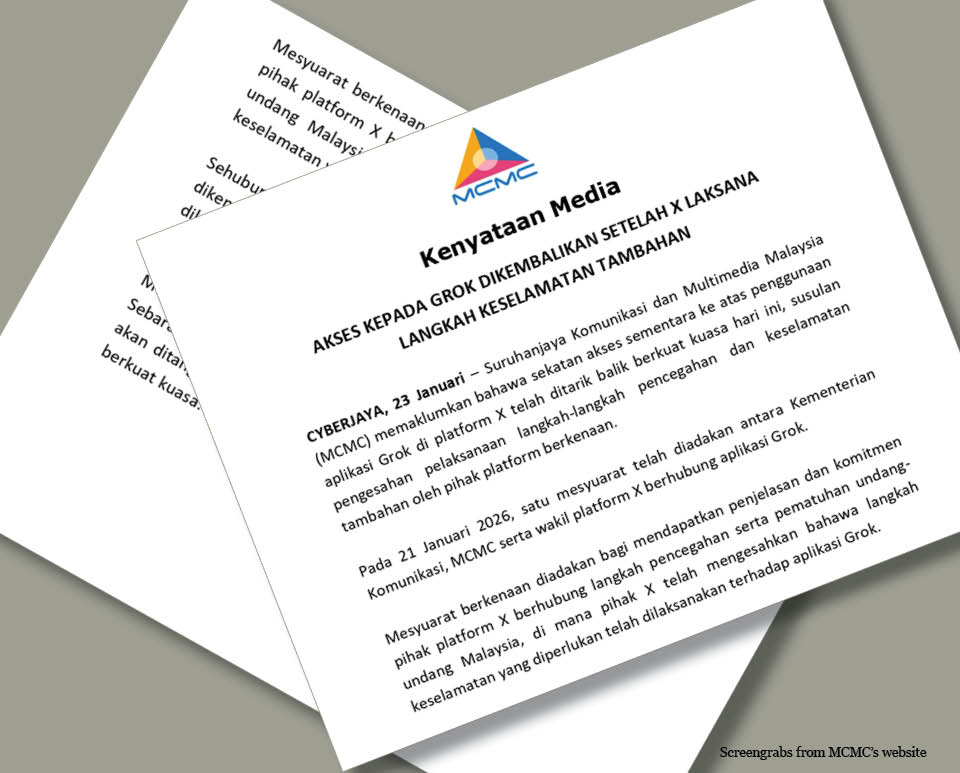
Malaysia, Indonesia and the Philippines restored access to Grok by the weekend after parent company X agreed to implement safety measures.
Authorities also assured critics that they would be keeping a close eye on the platform and emphasised that user safety “remains a priority”.
“Any failure to comply with, or any breach of, Malaysian law will be dealt with firmly in accordance with the applicable legal provisions,” the Malaysian Communications and Multimedia Commission (MCMC) said.
The move follows more than a week of high-profile government finger-wagging and threats at the U.S.-based AI platform across the region. At the centre of the row was X/Grok’s enabling unfettered distribution of inappropriate images.
MCMC said the temporary restriction on access to the Grok application on the X platform had been lifted “following confirmation that additional preventive and safety measures have been implemented by the platform”.
MCMC said preventive measures and compliance with Malaysian law had been discussed at a meeting with Grok/X reps on 21 January.
In the Philippines, the Department of Information and Communications Technology (DICT) acknowledged the explanation and corrective actions undertaken by X regarding concerns raised on its artificial intelligence chatbot, Grok, particularly on its image-generation capabilities. The ban, imposed on 16 January, was lifted on 21 January.
DICT said its action was in line with President Ferdinand Marcos Jr.’s order "to ensure a safe digital space for every Filipino".
The country's inter-agency technical assessment, led by the Cybercrime Investigation and Coordinating Center (CICC) and the National Telecommunications Commission (NTC), in coordination with relevant government agencies, found that Grok had "previously been associated with the generation of non-consensual, sexually explicit, and manipulated images, which prompted regulatory actions in several other jurisdictions including Indonesia and Malaysia".
"These concerns raised serious implications for digital safety, privacy, and the protection of vulnerable sectors, especially women and children," DICT said.
“Protecting Filipino users remains our paramount concern. At the same time, we support responsible innovation and recognize the role ...
Malaysia, Indonesia and the Philippines restored access to Grok by the weekend after parent company X agreed to implement safety measures.
Authorities also assured critics that they would be keeping a close eye on the platform and emphasised that user safety “remains a priority”.
“Any failure to comply with, or any breach of, Malaysian law will be dealt with firmly in accordance with the applicable legal provisions,” the Malaysian Communications and Multimedia Commission (MCMC) said.
The move follows more than a week of high-profile government finger-wagging and threats at the U.S.-based AI platform across the region. At the centre of the row was X/Grok’s enabling unfettered distribution of inappropriate images.
MCMC said the temporary restriction on access to the Grok application on the X platform had been lifted “following confirmation that additional preventive and safety measures have been implemented by the platform”.
MCMC said preventive measures and compliance with Malaysian law had been discussed at a meeting with Grok/X reps on 21 January.
In the Philippines, the Department of Information and Communications Technology (DICT) acknowledged the explanation and corrective actions undertaken by X regarding concerns raised on its artificial intelligence chatbot, Grok, particularly on its image-generation capabilities. The ban, imposed on 16 January, was lifted on 21 January.
DICT said its action was in line with President Ferdinand Marcos Jr.’s order "to ensure a safe digital space for every Filipino".
The country's inter-agency technical assessment, led by the Cybercrime Investigation and Coordinating Center (CICC) and the National Telecommunications Commission (NTC), in coordination with relevant government agencies, found that Grok had "previously been associated with the generation of non-consensual, sexually explicit, and manipulated images, which prompted regulatory actions in several other jurisdictions including Indonesia and Malaysia".
"These concerns raised serious implications for digital safety, privacy, and the protection of vulnerable sectors, especially women and children," DICT said.
“Protecting Filipino users remains our paramount concern. At the same time, we support responsible innovation and recognize the role of emerging technologies in national development, provided these technologies operate within the bounds of Philippine law and uphold human dignity,” DICT Secretary Henry Aguda said.
“We checked the safeguards that xAI has put in place, and we are satisfied,” Cybercrime Investigation and Coordinating Center (CICC) Deputy Executive Director Renato Paraiso added.
Previous

Next